
Hagia Sophia Architecture: What Makes It Extraordinary
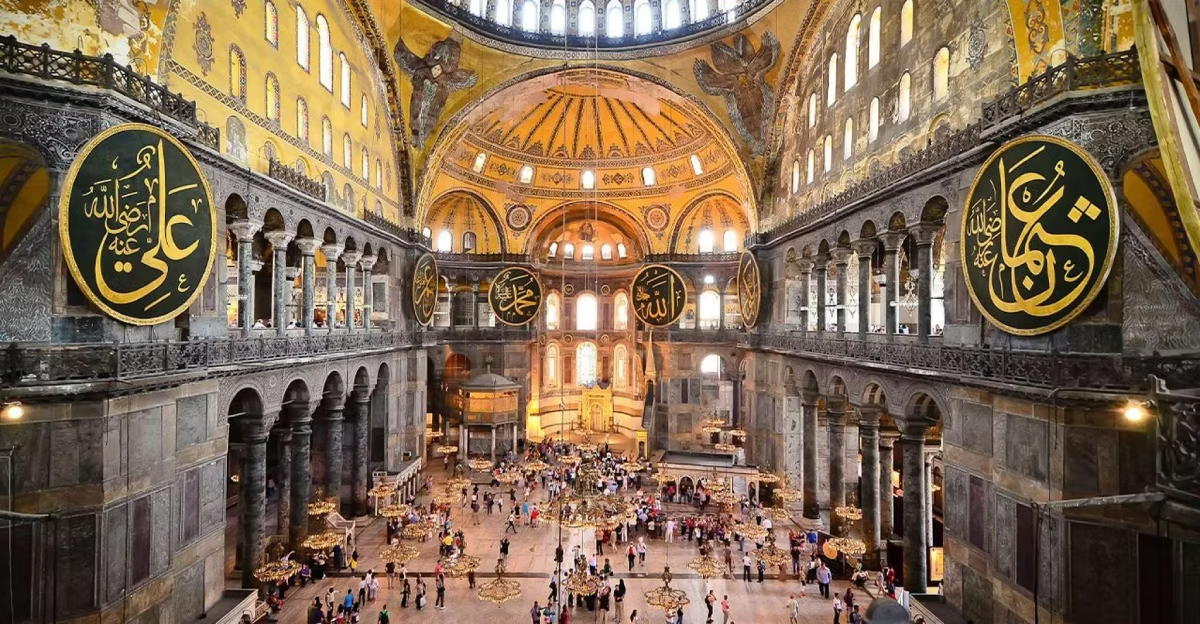
Hagia Sophia’s architecture is extraordinary primarily for its central dome — 31 metres in diameter, 55.6 metres high — and the structural system that supports it. The dome rests on four pendentives (curved triangular surfaces transitioning from a square base to a circular dome), supported by four massive piers concealed within the walls, and flanked by two half-domes that distribute the lateral thrust outwards. This system created an interior space of unprecedented scale that appeared — to 6th-century observers — to be held up by light alone. It defined Byzantine religious architecture for centuries and profoundly influenced Ottoman mosque design.
Hagia Sophia was built in an era when structural engineering operated without algebra, without calculus, and without computer modelling. Its architects — Anthemius of Tralles and Isidore of Miletus, who were mathematicians rather than traditional builders — solved structural problems that had never been solved at this scale before.
The result stood for nearly a thousand years as the largest domed space in the world, and continues to stand as one of the most technically remarkable buildings ever constructed.
The Central Dome: The Core Achievement
The central dome of Hagia Sophia spans 31.24 metres in diameter and rises to 55.6 metres above the floor — equivalent to an 18-storey building. At the time of its completion in 537 AD, it was the largest dome in the world, a record it held for nearly 1,000 years. The dome is pierced by 40 windows at its base, which create the impression of the dome floating on a ring of light — described by the 6th-century historian Procopius as “suspended from heaven by a golden chain.” The dome is not a perfect hemisphere — it is a slightly flattened spherical form, which reduces the outward thrust that a fuller hemisphere would generate.
The dome is the first thing that strikes every visitor — from both the upper gallery looking up and across, and from the prayer hall below looking up from the floor. But understanding what is extraordinary about it requires understanding the structural problem it solves.
A circular dome generates outward thrust at its base — the tendency of the curved surface to spread outwards as it pushes down. This is why earlier large domes — the Pantheon in Rome, for instance — sit on solid cylindrical walls that can absorb this thrust. The problem with that solution is that it creates a heavy, opaque base that blocks light and makes the interior feel enclosed.
Justinian’s architects wanted the opposite: a dome that appeared to float in light, separated from its supports by a ring of windows. The solution required a completely different approach to managing the dome’s structural forces.
Pendentives: The Key Structural Innovation
Pendentives are the curved triangular surfaces that form the transition between a square base and a circular dome. In Hagia Sophia, four pendentives connect the circular base of the dome to the four great arches that support it, which in turn rest on four massive piers concealed within the walls. This system transfers the dome’s weight and outward thrust down through the pendentives and arches to the piers and the ground. The pendentive solution allowed the dome to be separated from its supporting structure by windows, creating the appearance of a floating dome that so astonished contemporary observers.
Pendentives had been used in earlier buildings, but never at the scale and ambition of Hagia Sophia. The four pendentives at Hagia Sophia are each enormous spherical triangles — the geometry that allows a circular dome to sit on a square-plan building without any direct connection between the dome and the walls.
In the upper gallery, you are standing on the level of the gallery galleries that flank the nave — close enough to see the pendentives clearly and understand their geometry. Each one is a quarter of a sphere, curving from a corner of the supporting square up to meet the base of the dome’s circular drum.
The Half-Domes: Managing Thrust
On the east and west sides of the central dome, two large half-domes extend outward, covering the main apse area and the entrance vestibule respectively. These half-domes serve a structural function beyond their visual effect: they help absorb and redirect the dome’s lateral thrust in the east-west direction, making the whole system more stable.
Below the half-domes, in turn, are smaller semi-domes and conches (quarter-sphere shapes covering the niches) that further distribute the structural loads. The visual effect — looking at the building from inside — is of a series of cascading curved surfaces descending from the central dome, an architectural composition of extraordinary spatial complexity.
The north and south sides of the dome — where the thrust is not absorbed by half-domes — are braced by massive external buttresses added in successive phases, including during Sinan’s 16th-century reinforcement works.
The Window System and the Experience of Light
Hagia Sophia has 40 windows at the base of the central dome, plus extensive window openings in the tympanum walls (the flat wall surfaces between the main arches), the gallery levels, and the semi-domes. This unprecedented density of glazed openings was specifically designed to create the impression that the dome floated unsupported — the windows at the dome’s base separate it visually from its structural supports. The 6th-century historian Procopius described the effect as the dome appearing “suspended from heaven by a golden chain,” and the contemporary sensation of the building being made of light rather than stone.
Standing in the upper gallery at 9:00am on a clear morning, when the low sun enters through the eastern windows and creates pools of light across the gold mosaic surfaces, it is still possible to understand what Procopius meant. The building was designed to be experienced as light — the gold tesserae of the mosaics were set at deliberate angles to catch and scatter the light from multiple window sources, covering the surfaces in a shimmering, diffuse luminosity that no single lamp or fire could replicate.
The architects achieved this by breaking up the structural mass wherever possible — recessing the supporting piers into the wall fabric, inserting columns between the piers to open up the ground-level arcades, and using the thin brick vaults of the galleries to minimise the apparent weight of the upper structure. The result is a building that feels inexplicably large and inexplicably light for its structural components.
The Materials
The materials of Hagia Sophia were sourced from across the Byzantine Empire — an intentional statement of imperial reach and resource:
Porphyry: The deep red-purple stone from quarries near the Red Sea in Egypt, associated with imperial power in Byzantine culture. Used for columns in the nave galleries.
Verd antique (serpentine marble): The dark green marble from Thessaly in Greece. Used for column shafts throughout the building.
Yellow Numidian marble: From North Africa — warm honey-coloured stone used for wall revêtment.
White Proconnesian marble: From the island of Proconnesos (Marmara Island) in the Sea of Marmara — the primary white marble used for floors, columns, and architectural elements.
Brick: The dome and vaults are constructed in thin Byzantine brick (much thinner than Roman brick) with thick mortar joints — a technique that reduces weight at the highest structural points.
The visible effect of these varied materials — the alternating green and red columns, the polychrome marble revetments on the gallery walls — contributes significantly to the building’s visual richness, which operates at multiple scales from the overall spatial composition down to the individual stone pattern.
The Ottoman Additions: Sinan’s Reinforcement
When the great Ottoman architect Sinan examined Hagia Sophia in the 16th century, he found a building that had survived multiple earthquakes but showed signs of the accumulated structural stress. His interventions — particularly the addition of large external buttresses on the north and south sides — significantly stabilised the building and are responsible for much of its current silhouette from the exterior.
Sinan clearly studied Hagia Sophia intensively — his own masterpiece, the Süleymaniye Mosque, and his greatest creation, the Selimiye Mosque in Edirne, both engage directly with the structural and spatial problems that Hagia Sophia represents. The cascading semi-dome system of the Blue Mosque (built by Sinan’s student Sedefkâr Mehmed Agha) is an explicit response to Hagia Sophia’s spatial model.
The Building’s Influence
Hagia Sophia’s influence on subsequent religious architecture is immeasurable:
Byzantine churches: The spatial and structural model of Hagia Sophia — centralised plan, dome on pendentives, cascading half-domes — defined Byzantine church architecture for centuries throughout the Orthodox world, from the churches of Ravenna to the cathedrals of Russia.
Ottoman mosques: The great Ottoman imperial mosques — the Blue Mosque, the Süleymaniye, the Selimiye — all engage with Hagia Sophia as a reference point, whether seeking to match its scale, replicate its structural logic, or surpass it in specific aspects.
Western European architecture: The Hagia Sophia dome influenced Renaissance architects who encountered it through written descriptions and, later, direct study. The dome of St. Peter’s Basilica in Rome — designed by Michelangelo — shows the influence of Byzantine structural thinking filtered through centuries of Italian architectural development.
Seeing the Architecture in the Visiting Area
From the upper gallery, the best architectural views are:
The pendentives: Look at the corners where the dome’s circular base meets the square of the main supporting arches. The curved triangular pendentives — each decorated with enormous seraph figures in the Byzantine period, now covered — are clearly visible and the geometry of the structural system becomes legible.
The dome from below: From the central walkway of the gallery, looking up at the dome and across at the ring of 40 windows, you can appreciate both the scale and the light effect that defines the interior experience.
The half-domes: Looking east from the gallery walkway, the main half-dome covering the apse is visible — its cascading conch niches and the window lighting system that connects it to the central dome.
The column systems: The galleries on the north and south sides — where you are walking — are supported by column arcades. The columns are spolia (reused ancient columns from earlier buildings) selected for size and colour to create the visual rhythm of the arcading. See our what to see inside guide for the full visitor route.
Frequently Asked Questions
How was Hagia Sophia built so quickly?
The building was completed in approximately five years and ten months (February 532 – December 537 AD). Contemporary accounts describe a workforce of 10,000 labourers and 100 master builders working simultaneously in two teams — one on each side of the building. The use of thin Byzantine brick (lighter than Roman brick) and pre-fired kiln products allowed faster construction than traditional Roman concrete.
Has Hagia Sophia survived earthquakes?
Yes — multiple. The dome partially collapsed in 558 AD and was rebuilt. The building survived the major earthquakes of 869, 1344, and 1509, among others, with varying degrees of damage and repair. The external buttresses added over centuries — particularly Sinan’s reinforcements in the 16th century — significantly improved its structural resilience.
What is the dome made of?
The dome is constructed in lightweight Byzantine brick with thick mortar joints. The use of lightweight porous brick (some accounts suggest porous volcanic brick from the island of Rhodes was used for the dome) reduces the weight at the highest structural point, reducing the outward thrust the supporting structure must resist.
Is Hagia Sophia the largest dome in the world?
No — not by far in modern terms. The dome of St. Peter’s Basilica in Rome (42 metres diameter) and many modern structures exceed it in size. But for nearly 1,000 years after its completion in 537 AD, it was the largest dome in the world — a record that stood until the completion of the Florence Cathedral dome (designed by Brunelleschi) in 1436.
