
The Deesis Mosaic: Hagia Sophia’s Most Famous Artwork
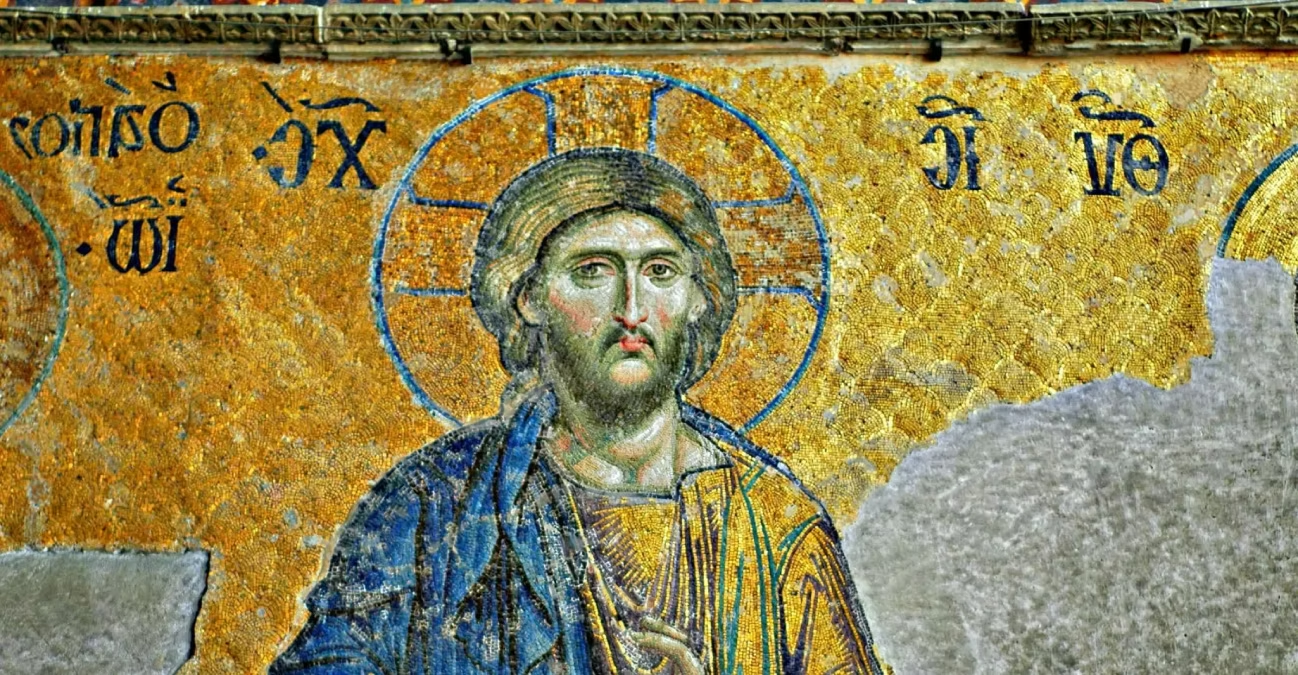
The Deesis Mosaic is a large Byzantine mosaic in the south gallery of Hagia Sophia’s upper Visiting Area, dating from approximately 1261 AD. It depicts Christ Pantocrator flanked by the Virgin Mary and John the Baptist in an intercessory composition. It is widely regarded as one of the finest surviving examples of Byzantine art — notable for the naturalism and psychological depth of the faces, which anticipate the humanism of Italian Renaissance painting. The lower third of the mosaic is missing, lost when the gallery floor was raised during the Ottoman period.
The Deesis Mosaic is the reason many people make the journey to Hagia Sophia. It is, by most assessments, one of the great works of art in the world — not just of Byzantine art, not just of the medieval period, but of art at any scale in any tradition. It is also, for most first-time visitors, the most unexpectedly moving experience in the building. This guide gives you everything you need to understand it fully before you stand in front of it.
The word “Deesis” (δήησις) means “entreaty” or “supplication” in Greek. The theological meaning of the composition is specific: the Virgin Mary and John the Baptist — the two most important intercessors in Eastern Orthodox theology — are shown in postures of supplication, slightly turned towards Christ, their hands extended in gestures of prayer. They are asking Christ, as divine judge, for mercy on behalf of humanity. The composition was used throughout Byzantine religious art, but the Hagia Sophia version is its greatest surviving example.
What Is the Deesis Mosaic?
The Deesis Mosaic at Hagia Sophia is a large Byzantine mosaic in the south gallery (upper Visiting Area), measuring approximately 4.8 metres wide by 6 metres tall (in its complete original state). It dates from approximately 1261 AD and depicts Christ Pantocrator at the centre, flanked by the Virgin Mary on the left and John the Baptist on the right — the three figures arranged in the traditional Deesis (Greek: “entreaty”) composition, symbolising the intercession of the Virgin and John for humanity before Christ as divine judge. The lower third of the mosaic is missing. The surviving upper section is composed of gold, silver, and coloured glass tesserae set in lime mortar.
When Was It Made and Why?
The Deesis Mosaic dates from approximately 1261 AD — the year Byzantine Emperor Michael VIII Palaeologus retook Constantinople from the Latin Empire that had occupied it since the Fourth Crusade of 1204. The mosaic is associated with the Palaiologan Renaissance, a period of remarkable artistic achievement in Byzantine art characterised by greater naturalism, psychological depth, and classical influence than earlier Byzantine styles. The commission of major new mosaics for Hagia Sophia after the recovery of Constantinople was likely a deliberate statement of Byzantine cultural and religious restoration.
The period of the Latin occupation (1204–1261) had seen the systematic looting of Hagia Sophia’s accumulated treasures — its golden altarware, its relics, its liturgical silver. The Latin emperors stripped the building. When Michael VIII retook Constantinople, restoring and enriching Hagia Sophia would have been an obvious priority — both as religious duty and as political statement.
The Deesis may have been part of this restoration programme, though the precise patronage and date of commission are not definitively documented. The artistic style places it firmly in the Palaiologan period: the naturalistic modelling of the faces, the use of subtle colour gradation in the flesh tones, and the psychological expressiveness of the figures are all characteristic of the finest Palaiologan artistic production.
What Makes It Extraordinary?
The Face of Christ
The central face of Christ in the Deesis is the feature that most consistently moves visitors who spend time with it. What makes it exceptional:
Naturalism and psychological depth. Byzantine art before the Palaiologan period was predominantly hieratic — formal, frontal, flat, concerned with spiritual significance rather than human presence. The Deesis Christ has a quality of human presence that is qualitatively different. The modelling of the beard and hair, the subtle asymmetry of the face, the quality of the gaze — these create an image that reads as a person rather than a type.
The gaze. The eyes of the Deesis Christ are one of its most discussed features. They look directly at the viewer and yet seem to look through the viewer simultaneously — a quality that has been described as simultaneously intimate and cosmic. This is partly a function of the mosaic technique (the slight convexity of the eye area in the tesserae setting creates a gleam) and partly a function of the draughtsmanship of the original cartoon on which the mosaic was based.
The colour modelling. The flesh tones in the face are rendered with a sophistication that anticipates Italian Renaissance painting. Rather than the flat application of a single flesh colour, the Deesis uses multiple tones — from pale highlights to warm mid-tones to deeper shadows — blended through the careful selection and placement of individual tesserae. At close range, the surface appears as a mosaic of small coloured fragments; at normal viewing distance, the effect is of a smoothly modelled, three-dimensional face.
The Technical Execution
The Deesis Mosaic is composed of millions of individual tesserae — small pieces of gold-foil-backed glass, silver-foil-backed glass, and coloured glass set into lime mortar. The gold tesserae are set at very slightly varying angles (not all parallel to the wall surface) so that they catch and scatter light from multiple directions simultaneously, creating the characteristic Byzantine gold shimmer. The flesh tones are rendered by grading between multiple closely related colours through the selective placement of individual tesserae — a technique that required extraordinary skill and produces effects comparable to oil painting when viewed at distance.
The technical mastery of the Deesis is most apparent at close range. Move to within a metre or two of the mosaic (the gallery barrier allows this) and look at the face of Christ:
Individual tesserae visible at close range. Each small piece of glass is distinct — some gold, some silver, some in the complex range of greens, ochres, pinks, and browns that compose the flesh tones. The surface is slightly uneven, with the individual tesserae proud of each other by tiny amounts.
Gold background setting. The gold background tesserae are set at angles that vary slightly from each other, creating a surface that reflects different portions of ambient light from different positions. This is why the gold background seems to glow — it is not reflecting light uniformly but scattering it in multiple directions simultaneously.
Step back and the image resolves. At normal viewing distance (2–4 metres), the individual tesserae disappear and the face reads as a seamlessly modelled whole. This is the fundamental perceptual achievement of Byzantine mosaic art — a technique that appears crude at extreme close range and reveals its sophistication at viewing distance.
What Is Missing and Why?
The lower third of the Deesis — the hands, lower drapery, and feet of all three figures — is absent. The surviving mosaic ends approximately at the level of the figures’ chests and upper arms.
What happened: When the Ottoman authorities converted Hagia Sophia to a mosque in 1453, they raised the floor level of the south gallery. The lower portion of the Deesis — which was below the new floor level — was physically destroyed in this process. The upper section, which remained above floor level, was plastered over and thus preserved.
When it was uncovered: The American Byzantine scholar Thomas Whittemore began uncovering the mosaics in the 1930s during the secular museum period. The Deesis was revealed and documented by Whittemore’s team, and its condition at the time of uncovering was essentially what you see today.
What is gone permanently: The missing lower third — the hands of Christ (in the gesture of blessing), the hands of the Virgin and John in their intercessory gestures, and the lower figures — is lost without documentary record of its original appearance. The upper section’s extraordinary quality suggests the missing portion would have been equally refined.
Where Exactly to Find the Deesis
Location: South gallery, upper Visiting Area. It is at the far end of the south gallery from the gallery entrance — the section of the gallery that is furthest from the tourist ramp and closest to the main apse of the building.
How to get there: Enter the gallery from the tourist ramp and proceed along the gallery circuit. Follow your audio guide’s directions (the Deesis is a key stop on all audio guide sequences) or, if visiting independently, walk through the north gallery section and continue into the south gallery. The Deesis is on the south wall of the south gallery — the wall facing south, at approximately eye height. A low barrier separates visitors from the mosaic surface.
Best viewing position: Directly in front of the mosaic, at the barrier, for close study of the tesserae and technical execution. Step back to approximately 2–3 metres for the full compositional reading at which the mosaic was designed to be experienced.
The Deesis in Art Historical Context
The Deesis is significant not just as an isolated masterwork but as an indicator of where Byzantine art was heading before the fall of Constantinople in 1453 ended the tradition.
The naturalism of the Deesis Christ — particularly the modelling of the face, the quality of the gaze, and the psychological depth — places it in a continuum with Italian Trecento painting (Cimabue, Duccio, and early Giotto are approximately contemporary). Byzantine art and Italian art were in dialogue during this period — Italian artists travelled to Constantinople, Byzantine artists worked in Italy — and the Palaiologan Renaissance in Byzantine painting parallels and intersects with the Italian proto-Renaissance.
Had Constantinople not fallen to the Ottomans in 1453, this tradition would presumably have continued its development. The Deesis represents one of the high points of what that tradition achieved — and a pointer to what it might have become.
Practical Tips for Experiencing the Deesis
Arrive at 9:00am. The south gallery becomes congested by 10:30am in peak season. At opening, you can stand in front of the Deesis with no one between you and the mosaic for extended periods — the conditions for which it was designed. See our best time to visit guide for details.
Read the context before you go. The Deesis rewards preparation. Knowing what you are looking at — the theological meaning of the Deesis composition, the date and artistic context of the Palaiologan Renaissance, the survival story of the mosaic — transforms the experience from appreciation of a beautiful image into something considerably more resonant.
Allow 15–20 minutes here. Most visitors give the Deesis 3–5 minutes. Give it 15. Look at the face from close range, then from normal viewing distance, then close again. The quality of the image reveals itself differently at different distances.
No flash photography. Flash completely washes out the gold tesserae and flattens the image. Disable flash before entering the gallery. Your camera’s low-light or night mode will produce far better results. See our photography guide for technical tips.
Frequently Asked Questions
What does “Deesis” mean?
“Deesis” (δήησις) is Greek for “entreaty” or “supplication.” The composition shows the Virgin Mary and John the Baptist in postures of prayer before Christ, interceding on behalf of humanity.
When was the Deesis Mosaic made?
Approximately 1261 AD, during the reign of Emperor Michael VIII Palaeologus immediately following the Byzantine recovery of Constantinople from the Latin occupation. The exact date and patronage are not definitively documented.
Why is the lower section of the Deesis missing?
The lower third was destroyed when the Ottoman authorities raised the floor level of the south gallery during the conversion of Hagia Sophia to a mosque in 1453. The upper section survived by being plastered over rather than physically destroyed.
How large is the Deesis Mosaic?
The surviving section measures approximately 4.8 metres wide and 3.5 metres tall. In its complete original state (before the lower third was lost), it would have measured approximately 4.8 metres by 6 metres.
Is the Deesis Mosaic the most famous artwork in Hagia Sophia?
Yes — by most assessments. It is certainly the most discussed, most reproduced, and most widely regarded as the artistic highlight of the Visiting Area. The Empress Zoe panel and the Virgin and Child apse mosaic are also significant, but neither approaches the Deesis in terms of artistic quality or art historical importance.
