
Hagia Sophia, Blue Mosque & Hippodrome Guided Tour: Full Review
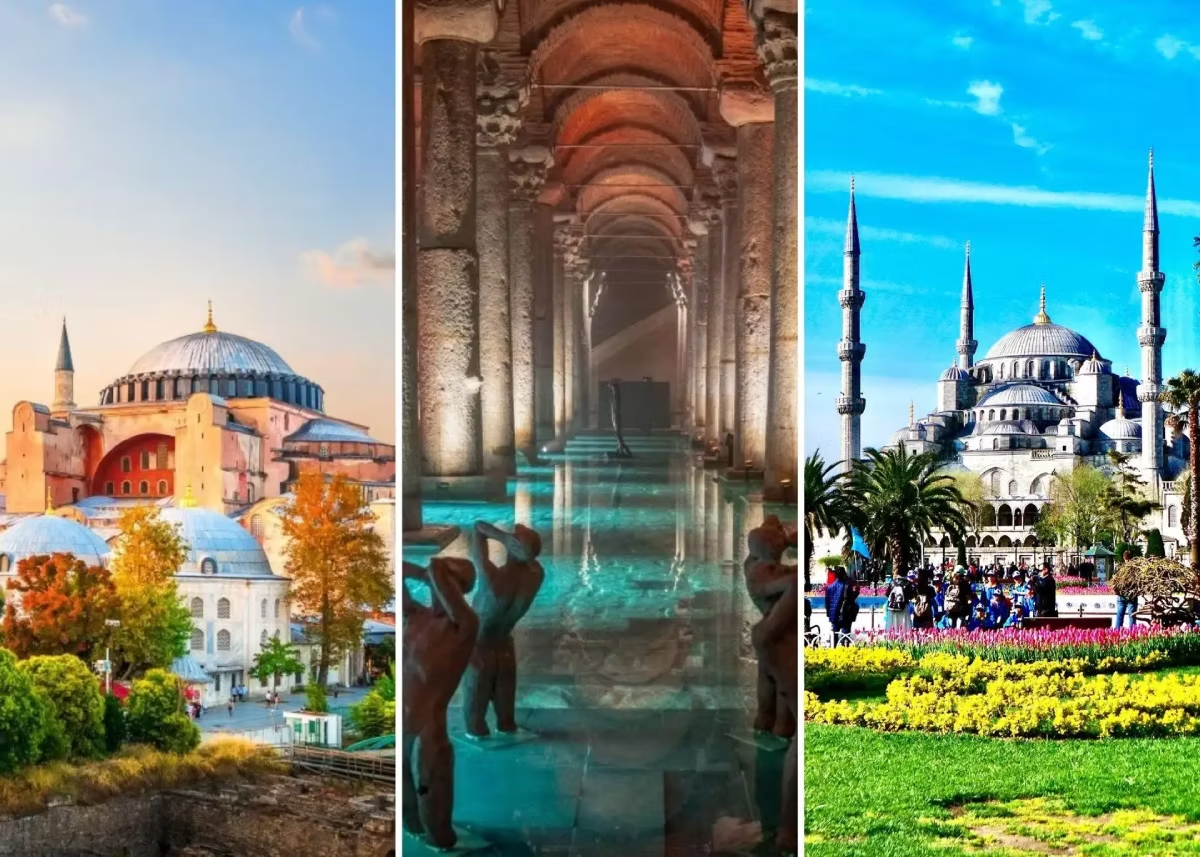
The Hagia Sophia, Blue Mosque and Hippodrome guided tour is an excellent choice for visitors with a particular interest in Byzantine history. Adding the Hippodrome to the standard Hagia Sophia + Blue Mosque pairing gives the tour a crucial layer of urban context — the Hippodrome was the social and political heart of Byzantine Constantinople, and understanding it transforms how you read the surrounding monuments. The tour runs approximately 3 hours and includes skip-the-line entry at Hagia Sophia.
Hagia Sophia and the Blue Mosque are the two buildings most visitors associate with Sultanahmet. But the open square between them — Sultanahmet Square — is itself one of the most historically significant public spaces in the world. It occupies the site of the Hippodrome of Constantinople, the ancient chariot racing track and political arena that was the beating heart of Byzantine public life for over a millennium. Adding the Hippodrome to your Hagia Sophia visit is not just a bonus stop — it is the context that makes the whole district legible.
This review covers what the guided tour includes, what the Hippodrome adds, and whether the three-site itinerary is the right choice for your visit.
Top Tickets
What Is Included?
The Hagia Sophia, Blue Mosque and Hippodrome guided tour includes skip-the-line entry to Hagia Sophia’s Visiting Area, expert-guided commentary at the Hippodrome of Constantinople (Sultanahmet Square) covering its three surviving ancient monuments, and guided access to the Blue Mosque. A licensed guide leads the group throughout. The tour runs approximately 3 hours and is designed as a single continuous experience through Sultanahmet’s most historically significant sites.
What the tour covers:
- Skip-the-line Hagia Sophia entry — entry pass collected efficiently before the tour begins; no ticket booth queue
- Licensed guide throughout all three sites
- Hagia Sophia Visiting Area — approximately 60–75 minutes with guided commentary on the Byzantine mosaics, Ottoman additions, and architectural engineering
- The Hippodrome monuments — guided stop in Sultanahmet Square covering the three surviving ancient monuments: the Egyptian Obelisk, the Serpent Column, and the Column of Constantine
- The Blue Mosque — approximately 45–60 minutes covering the Iznik tile interior, the six minarets, the dome system, and the relationship between the mosque and Hagia Sophia
- Small group format — typically 8–15 participants
Not included: Transport to/from Sultanahmet, entry to any other landmark, meals, guide gratuity.
What Does the Hippodrome Add?
The Hippodrome of Constantinople (now Sultanahmet Square) was the central public space of Byzantine Constantinople — a chariot racing track and political arena that could seat 100,000 spectators. It was where emperors were acclaimed and dethroned, where the 532 Nika riots killed 30,000 people, and where Mehmet II staged the triumphal events of his 1453 conquest. Three ancient monuments survive in what is now Sultanahmet Square: the Egyptian Obelisk (originally from Karnak, c. 1450 BC), the Serpent Column (from Delphi, 479 BC), and the Column of Constantine (10th century AD).
Most visitors walk through Sultanahmet Square without realising they are standing on one of the most historically charged spaces in the world. A guide who knows the Hippodrome’s history makes that invisible past visible — pointing out the surviving monuments, explaining their origins and how they got to Constantinople, and describing the events that unfolded in this space over 1,000 years of Byzantine history.
The Egyptian Obelisk (Dikilitaş): Originally erected at the Temple of Karnak in Egypt around 1450 BC by Pharaoh Thutmose III, it was brought to Constantinople by Emperor Theodosius I in 390 AD. The marble base on which it stands is covered in detailed relief sculptures showing Theodosius watching chariot races from the imperial box — a remarkable surviving image of life in the Byzantine Hippodrome.
The Serpent Column (Yılanlı Sütun): Cast from the melted shields of Persian soldiers after the Greek victory at Plataea in 479 BC, it originally stood at the Temple of Apollo at Delphi. Constantine the Great brought it to Constantinople when he founded the new capital in 330 AD. Three intertwined bronze serpents originally supported a golden tripod — most of what survives today is the column shaft.
The Column of Constantine (Çemberlitaş): A 10th-century Byzantine column, significantly more modest than the other two but marking the southern end of the racing track’s central spine (the spina) around which chariots raced.
For more context on these monuments, see our attractions near Hagia Sophia guide.
Book This TourThe Tour Experience: What to Expect
Your guide typically meets the group near the Hagia Sophia tourist entrance at the scheduled start time. The tour follows a natural geographic sequence through the Sultanahmet district.
Hagia Sophia (60–75 minutes): The guide leads the group through the upper gallery with commentary on the Deesis Mosaic, the Empress Zoe panel, the Viking runic inscriptions, the dome, and the Ottoman additions. Questions are welcomed throughout.
The Hippodrome (15–20 minutes): After exiting Hagia Sophia, the guide leads the group across Sultanahmet Square — the ancient Hippodrome — stopping at each of the three surviving monuments. This section is outdoors and brief but historically dense. The guide typically frames the Hippodrome as the context within which Hagia Sophia was built — the cathedral rising on the edge of the empire’s greatest public arena.
The Blue Mosque (45–60 minutes): The guide leads the group into the Sultan Ahmed Mosque with commentary on the architecture, the Iznik tiles, the six minarets, and the deliberate architectural dialogue with Hagia Sophia across the square. The guide typically draws explicit connections between what you saw at Hagia Sophia and what you are looking at in the Blue Mosque — the dome systems, the columns, the use of light.
Total duration: Approximately 3 hours.
Guided Tour vs Self-Guided Combo
The guided tour of Hagia Sophia, the Blue Mosque and the Hippodrome delivers expert live commentary and a coherent historical narrative connecting all three sites — context that audio guides and self-guided visits cannot replicate. It costs more per person than self-guided combo tickets but provides a significantly richer experience, particularly for the Hippodrome section where there is no on-site audio guide option.
The Hippodrome is where the guided format provides the clearest advantage over self-guided options. There is no audio guide for the Hippodrome monuments — a guide is the only way to get meaningful interpretation of the Egyptian Obelisk, the Serpent Column, and the Column of Constantine in situ. Self-guided visitors typically spend 5–10 minutes in the square without fully understanding what they are looking at. A guided group spends 15–20 minutes there and leaves with a completely different understanding of Byzantine Constantinople.
For the self-guided version of the Hagia Sophia + Blue Mosque pairing, see our combo ticket review. For all guided tour options, see our best guided tours guide.
Price and Value
This guided tour is priced per person and typically falls in the €40–€60 range depending on operator and season. For a three-site guided experience in one of the world’s most historically significant districts, this represents solid value — the Hippodrome commentary alone justifies the premium over a two-site self-guided visit.
For a full pricing overview across all ticket options, see our Hagia Sophia ticket prices guide.
Who Is This Tour Best For?
Visitors with a strong interest in Byzantine history for whom the Hippodrome is not an afterthought but a key part of understanding Constantinople. If you want to understand the city that Hagia Sophia was built for — the urban, political, and social context of the Byzantine world — the Hippodrome is essential.
First-time visitors to Istanbul who want expert-guided context across all three Sultanahmet landmarks in a single coherent session. The guide draws connections between the sites that make the district feel like a unified story rather than a collection of individual monuments.
Visitors who have already done Hagia Sophia self-guided and want a guided experience for their second visit — the Hippodrome commentary in particular transforms a familiar space.
Who Should Consider a Different Option?
Visitors who also want the Basilica Cistern or Topkapi Palace: Consider the half-day morning tour which covers more landmarks, or build your own day with a combo ticket.
Visitors who prefer self-guided exploration: The Hagia Sophia + Blue Mosque combo ticket provides audio guides at both mosques at a lower per-person cost, though without Hippodrome commentary.
Practical Tips
Book a morning departure. Morning tours reach Hagia Sophia at its quietest, with shorter security queues and better light for the mosaics. Most operators offer 9:00–10:00am departures.
The Hippodrome section is outdoors. Dress for the weather — sunscreen and water in summer, a layer in winter. The guide typically keeps this section to 15–20 minutes, but it is exposed to the elements.
Check the Blue Mosque prayer schedule. The mosque closes briefly to tourists during each of the five daily prayers. Your guide will time the tour to minimise disruption, but brief waits at the entrance are occasionally part of the experience.
Dress for both mosques. Covered shoulders, knees, and hair (for women) are required at both Hagia Sophia and the Blue Mosque. See our dress code guide for full details.
Frequently Asked Questions
Is the Hippodrome a separate attraction with an entry fee?
No — Sultanahmet Square (the Hippodrome site) is a public open space with no entry fee. The monuments are freely accessible; the value of the guided tour is the expert interpretation, not the access.
How large are the tour groups?
Typically 8–15 participants. Check the specific product listing for the maximum group size.
Is the tour available every day?
Most operators run this tour daily. Note that Hagia Sophia closes to tourists between 12:30 and 14:30 on Fridays — morning tours are advisable on Fridays.
Is skip-the-line entry included for the Blue Mosque?
The Blue Mosque has no entry fee and does not have a conventional ticket queue — guided access is included as part of the tour experience.
What is the cancellation policy?
Most bookings include free cancellation up to 24 hours before the tour date. Check the specific product page before booking.
