
Hidden Details at Hagia Sophia Most Visitors Miss
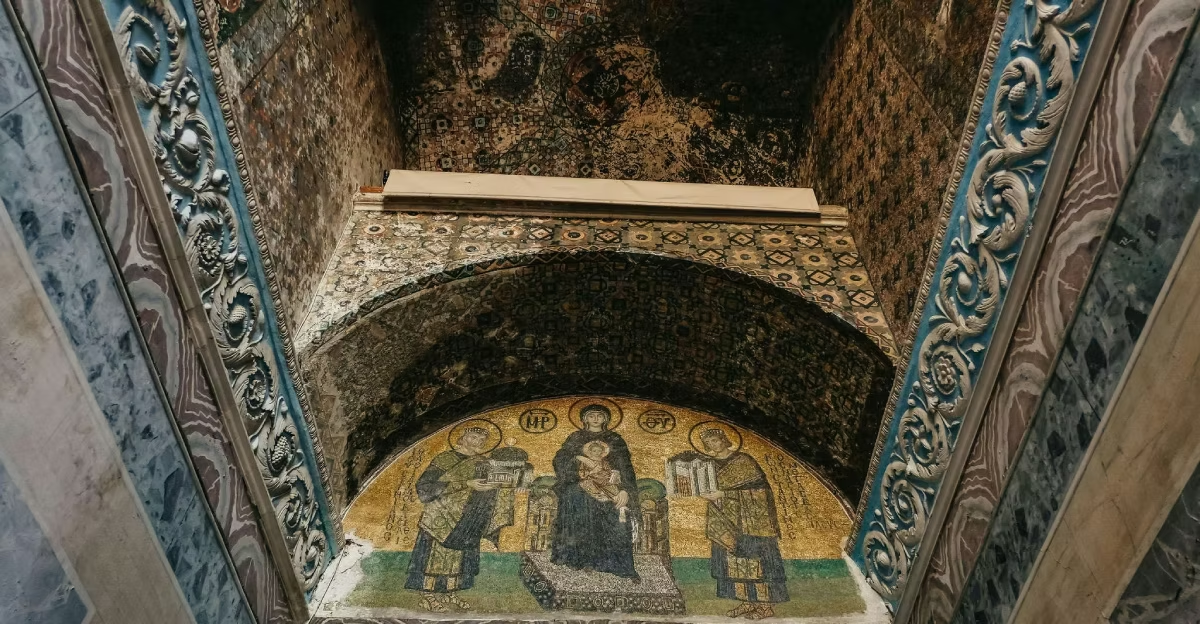
The details most visitors miss at Hagia Sophia include the Viking runic inscriptions on the gallery balustrade, the visible evidence of the Empress Zoe mosaic face replacements, the Omphalion on the ground floor (visible from the gallery), the Wish Column in the narthex, and the Varangian Guard graffiti. None of these are signposted — you need either a guide pointing them out or this guide to find them.
Hagia Sophia is so visually overwhelming that most visitors focus on the obvious — the dome, the mosaics, the sheer scale of the space — and miss the extraordinary details hiding in plain sight. The building is 1,500 years old and has been a cathedral, a mosque, a museum, and a mosque again. Every layer of that history left traces, and many of those traces are small, worn, and easy to walk straight past.
This guide identifies the most interesting hidden details in the Visiting Area, explains what they are and why they matter, and tells you exactly where to find each one.
1. The Viking Runic Inscriptions
The Viking runic inscriptions at Hagia Sophia are small carvings in the marble balustrade of the upper gallery’s south section, made by members of the Varangian Guard — Norse and Anglo-Saxon mercenaries who served as the elite bodyguard of the Byzantine emperors from the late 10th century onwards. The most legible inscription reads approximately “Halfdan carved these runes” in Old Norse. There are several inscriptions, most worn and partially illegible. They are not signposted and are easy to miss without guidance pointing you directly to the location.
Where to find them: In the south gallery, on the marble parapet balustrade — the low wall along the gallery edge overlooking the prayer hall below. Look carefully along the inner face of the parapet at approximately waist height. The inscriptions are small (a few centimetres in most cases), worn smooth by centuries of hands and weather, and do not look obviously different from the natural veining of the marble at a casual glance.
Why they matter: The Varangian Guard was one of the most remarkable institutions of the medieval world. Norse warriors — and later Anglo-Saxon warriors who fled to Constantinople after the Norman Conquest of England in 1066 — made the long journey east to serve as the personal bodyguard of the Byzantine emperors. They attended religious services at Hagia Sophia as part of their imperial duties, and the inscriptions they left behind are casual, personal marks — the equivalent of carving your initials into a tree. The fact that they appear in the most sacred space in Christendom, on a marble parapet that cost more than most Norse villages, makes them unexpectedly human.
Practical tip: Your audio guide will direct you to the specific location with much more precision than this description can provide. Without a guide, look along the south gallery parapet, particularly in the section closest to the south wall. Patience and close observation are required — they will not leap out at you.
2. The Empress Zoe Mosaic Face Replacements
Most visitors look at the Empress Zoe and Constantine IX mosaic panel and see a Byzantine devotional image. The detail most visitors miss is the evidence that the panel was altered — twice — and that the evidence of those alterations is visible in the mosaic itself.
Where to find it: In the south gallery, adjacent to the Deesis. The mosaic shows Christ enthroned, flanked by the Empress Zoe and her husband. Look carefully at the area around the emperor’s face — particularly the tesserae setting in the face itself compared to the surrounding areas of the mosaic.
What to look for: The tesserae around the emperor’s face show a slightly different pattern and tone from the surrounding mosaic. The replacement areas — where the plaster was reopened and new tesserae set — created subtle discontinuities in the colour matching and setting angle that are visible to a careful eye. The inscription above the emperor’s head was also altered, and the letter forms in the name panel are slightly inconsistent.
Why it matters: Empress Zoe of Byzantium (978–1050) was married three times. Each time she changed husbands, the face in this mosaic was chiselled out and replaced. The fact that this was done — that a mosaic in the most sacred space in the empire was treated as an updatable portrait rather than a sacred fixed image — tells you something vivid about Byzantine imperial culture and the relationship between religious art and political legitimacy.
3. The Omphalion (Visible from the Gallery)
Where to find it: Look down from the gallery into the prayer hall below. In the central floor area, there is a circular pattern of marble — a disc of porphyry and coloured stone approximately 4 metres in diameter, set into the floor. This is the Omphalion.
What it is: The Omphalion (Greek for “navel” or “centre”) was the focal point of Byzantine imperial ceremonial — the spot where Byzantine emperors were crowned. The circular design, with its concentric rings of different coloured marbles, marked the most symbolically charged location in the most symbolically charged building in the Byzantine world. The word “omphalos” (navel of the world) signals that this was understood as the literal centre of the universe — the point from which imperial power and cosmic order radiated outward.
Why most visitors miss it: The Omphalion is on the ground floor, which tourists cannot access. It is visible from the gallery above, but you have to know to look for it and know what you are looking at. From the gallery, it appears as a decorative floor pattern among many — unremarkable unless you understand its significance.
4. The Wish Column (Column of Saint Gregory the Wonderworker)
Where to find it: In the northwest corner of the narthex — the entrance vestibule you pass through on your way into the gallery from the tourist entrance. The column is encased in bronze and has a hole at approximately eye height.
What it is: A column that has been the subject of a folk belief for centuries — that inserting a thumb into the hole and rotating it through a full circle while maintaining contact with the metal surface grants a wish (or, in earlier versions of the legend, heals illness). The wetness inside the hole — from condensation and the accumulated moisture of thousands of hands — has been interpreted for centuries as evidence of the column’s miraculous properties.
The history of the belief: The tradition associated the column with Saint Gregory the Wonderworker in Byzantine times. The belief survived the Ottoman conversion and continues to attract visitors and worshippers today — both Muslim and Christian — suggesting that the folk religious significance of the column transcends its specific theological attribution.
Practical note: The column is not dramatically signposted but is findable with the description above. Many visitors stop here on their way in or out, and a small crowd around a column in the northwest corner of the narthex is often the clearest indicator of its location.
5. The Sebil (Ottoman Water Fountain) in the Narthex Area
Near the Wish Column area, an Ottoman-era sebil (charitable water fountain) is built into the narthex wall — a small marble recess where water was once dispensed to the public as an act of religious charity. The sebil is a small detail but a vivid physical reminder that the building has functioned as a working mosque for 567 years (and counting) — not merely a historical monument.
6. The Displaced Marble Opus Sectile Floors
Throughout the gallery circuit, sections of the marble floor show the original Byzantine opus sectile paving — geometric patterns of differently coloured marbles set into decorative compositions. The patterns vary across the gallery and reflect different periods of construction and repair. Most visitors walk across them without registering that the floor beneath their feet is itself a surviving piece of Byzantine decorative art.
What to look for: In the south gallery particularly, the marble floor shows geometric patterns — circular, interlocking, sometimes with the original colour contrast still vivid, elsewhere faded or replaced. The variation in pattern complexity and marble colour between different sections of the floor reflects the different patronage periods of gallery decoration.
7. The Seraph Mosaics in the Pendentives
Where to find them: Look at the four pendentives — the curved triangular surfaces in the corners below the dome — from the gallery level. Each originally contained a large mosaic of a seraph (a six-winged angelic figure). Three of the four seraph faces were covered by large metal discs during the Ottoman period (their representation as human-faced figures made them problematic in an Islamic context). The fourth — in the northeast pendentive — remains partially visible behind the metal covering.
Why they matter: The seraph mosaics represent the original Byzantine decorative programme for the dome zone — the theological statement that the dome was heaven, populated by its celestial inhabitants. The metal coverings are themselves a historical artefact — a physical record of the Ottoman approach to the building’s Christian imagery.
8. The Deesis Mosaic at Close Range
Most visitors look at the Deesis from a respectful distance — taking in the full composition. The hidden detail is what happens when you look closely at the technical execution of the mosaic rather than the image as a whole.
What to look for: At close range, the individual tesserae are visible — each one a small piece of gold-foil-backed glass or coloured glass set into lime plaster. The gold tesserae are set at very slightly varying angles — not all parallel to the surface — so that they catch and scatter light from multiple directions simultaneously. This is why the Deesis seems to glow rather than simply reflect: the deliberate irregularity of tesserae setting creates a diffuse luminosity that a perfectly flat surface could not achieve.
The transition areas in the face of Christ — where the flesh-tone tesserae grade from lighter to darker to model the three-dimensional form of the face — show a subtlety of colour gradation that rivals Italian fresco painting of the same period.
9. The Structural Seams in the Dome
From the gallery level, looking up at the dome’s interior, the observant visitor can trace the structural history of the building in the seams and discontinuities of the dome surface. The dome collapsed partially in an earthquake in 558 AD and was rebuilt by Isidore the Younger — the rebuilt section is visible as a subtle difference in the brick coursing and plaster finish at the upper sections of the dome.
What to look for: The transition between the original Justinianic dome sections (lower) and the post-earthquake rebuild (upper) is visible in the slight change in the curvature and surface texture of the dome interior. This is a detail that requires some knowledge of what you are looking for — it will not be obvious without context.
10. The Marble Revetment Patterns
Throughout the gallery walls, thin panels of polychrome marble — white, green, red, yellow — are applied to the wall surfaces in geometric compositions. The marble was sawn into thin sheets and applied symmetrically, so that adjacent panels are mirror images of each other, the natural veining of the stone creating symmetrical abstract patterns.
This was the standard Byzantine approach to decorative marble work, but the quality at Hagia Sophia — the rarity of the marbles, the precision of the cutting, the visual complexity of the resulting patterns — is exceptional. Visitors who stop and look at the wall surfaces carefully, rather than just the mosaics, discover an additional layer of decorative richness that most people walk past entirely.
Making the Most of the Hidden Details
Use a guide or audio guide. The hidden details described here are the kind of features that a knowledgeable guide makes immediate and vivid. An audio guide will direct you to the Viking inscriptions and the Empress Zoe alterations; a live guide can position you correctly, point out exactly what to look for, and provide the historical context that makes each detail significant. See our best guided tours guide for options.
Arrive early. The hidden details reward slow looking — and slow looking is significantly more comfortable when the gallery is not crowded. The first hour after opening provides the best conditions for the kind of close, patient observation that the Viking inscriptions and the mosaic face alterations require. See our best time to visit guide.
Read before you visit. Our history of Hagia Sophia and mosaics guide provide the context that makes these details legible. Knowing what you are looking for — and why it matters — transforms a casual observation into a genuine discovery.
Frequently Asked Questions
Where is the Viking graffiti in Hagia Sophia?
On the marble balustrade of the south gallery, at approximately waist height on the inner face of the parapet. Look carefully — the inscriptions are small and worn. An audio guide or live guide will direct you to the precise location.
What is the Omphalion at Hagia Sophia?
A circular marble disc inlaid in the ground-floor prayer hall, marking the spot where Byzantine emperors were crowned. It is visible from the upper gallery but not accessible to tourists, who are limited to the upper Visiting Area.
Is the Wish Column accessible to tourists?
Yes — the Wish Column (with its bronze casing and hole at eye height) is in the narthex area accessible to all visitors on their way into or out of the gallery circuit.
What did Empress Zoe do to the mosaic?
Empress Zoe was married three times. Each time she changed husbands, the face of her husband in the mosaic panel was chiselled out and a new face inserted. The evidence of these alterations — subtle discontinuities in the tesserae pattern around the emperor’s face — is visible in the existing mosaic.
