
What to See Inside Hagia Sophia: A Complete Guide (2026)

The Hagia Sophia Visiting Area (upper gallery) contains the Deesis Mosaic, the Empress Zoe and Constantine IX mosaic panel, the Virgin and Child apse mosaic, Viking runic inscriptions, panoramic views of the 31-metre central dome and the main prayer hall, and the Ottoman calligraphic medallions. The south gallery — where the Deesis is located — is the most historically and artistically significant section. Allow 60–90 minutes for a thorough visit.
Hagia Sophia’s Visiting Area is the upper gallery of the mosque — a circuit elevated above the main prayer hall that offers both direct access to the surviving Byzantine mosaics and sweeping elevated views of the building’s interior. It is not a large space by modern museum standards, but almost everything in it is extraordinary. This guide covers every significant feature in the order you will encounter them, with the context needed to understand what you are looking at.
The Layout of the Visiting Area
The Hagia Sophia Visiting Area is the upper gallery of the mosque, accessed via a ramp from the northeast tourist entrance. It forms a U-shaped circuit around the perimeter of the main nave — a north gallery, a south gallery, and a central walkway connecting them. The south gallery contains the most significant Byzantine mosaics (the Deesis, the Empress Zoe panel). The central walkway offers the best elevated views of the 31-metre dome. The circuit takes 60–90 minutes to complete at a thorough pace.
The visitor route:
Entering via the tourist ramp, visitors access the upper gallery and typically follow a circuit through the north gallery (left), across the central walkway with dome views, then through the south gallery (right — the most significant section for art and history), before exiting. Audio guides and live guides follow a similar sequence, though the exact route may vary slightly by operator.
Feature by Feature: What to See
The 31-Metre Central Dome
The central dome of Hagia Sophia spans 31 metres (approximately 102 feet) in diameter and rises 55.6 metres (182 feet) above the floor. It is supported by four pendentives — the triangular curved surfaces connecting the circular base of the dome to the square supporting structure below — a structural innovation that was revolutionary at the time of the building’s construction in 537 AD. The dome contains 40 windows at its base, creating the effect — described by contemporary accounts — of the dome appearing to float on a ring of light.
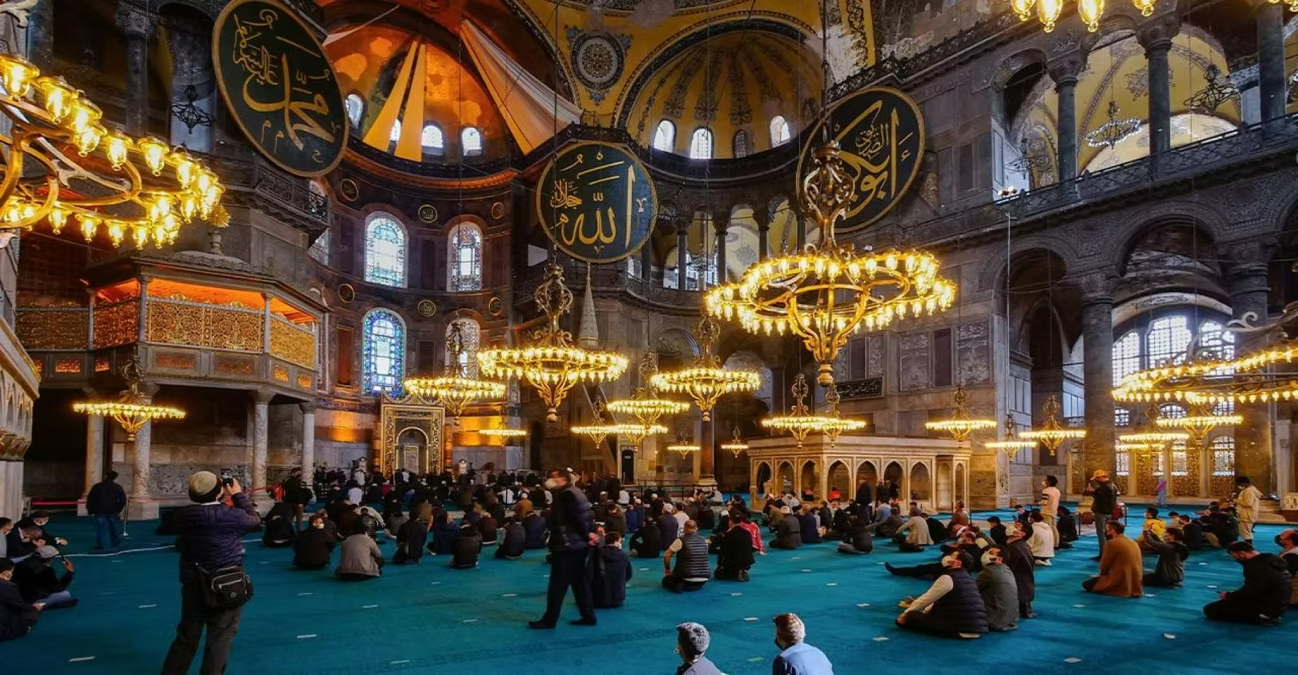
From the upper gallery, you can look directly up at the dome and appreciate both its scale and its engineering. The Ottoman calligraphic medallions hanging below — eight circular panels inscribed with the names of Allah, Muhammad, and the four caliphs — are 7.5 metres in diameter each, giving a sense of the interior scale that photographs often fail to convey.
A partially surviving Byzantine mosaic of Christ Pantocrator (Christ as ruler of the universe) is visible at the crown of the dome. The image was plastered over during the Ottoman period and partially restored — the visible fragments are faint but significant as the only surviving original decoration in the dome itself.
Why it matters: For nearly a thousand years after its completion in 537 AD, the Hagia Sophia dome was the largest in the world. The engineering solution — using pendentives to transfer the circular dome’s weight onto four square supporting arches — was not fully understood in the West until Renaissance architects studied it centuries later.
The Deesis Mosaic
The Deesis Mosaic in Hagia Sophia’s south gallery dates from approximately 1261 AD — the period immediately following the Byzantine recovery of Constantinople after the Latin occupation. It depicts Christ Pantocrator flanked by the Virgin Mary (left) and John the Baptist (right) in a traditional intercessory composition. It is widely considered one of the finest surviving examples of Byzantine art, particularly for the naturalism and psychological depth of the faces. The lower third of the mosaic is missing — lost during the Ottoman conversion in 1453 when the gallery floor level was altered. The mosaic is composed of gold, silver, and coloured glass tesserae set into a lime mortar ground.
The Deesis is the centrepiece of any Hagia Sophia visit and deserves extended attention. Stand close enough to see the individual tesserae — each one a tiny piece of coloured glass or gold foil set at a deliberate angle to reflect light towards the viewer. The cumulative effect of millions of these tiny elements is a luminosity that photographs do not fully capture.
The face of Christ in the Deesis is one of the most psychologically complex and humanistically rendered images in all of Byzantine art — a departure from the more hieratic, frontal traditions of earlier Byzantine icon painting. The naturalism of the flesh tones, the modelling of the beard and hair, and the quality of the gaze make it feel startlingly contemporary for an image made over 760 years ago.
What is missing and why: The lower third of the mosaic — the hands, the lower drapery — was lost when the gallery floor was raised during the Ottoman conversion in 1453. The upper portion, which survived plastered over until the 1930s restoration, is what you see today. For full context on this mosaic, see our dedicated Deesis Mosaic guide.
The Emperor Constantine IX and Empress Zoe Mosaic Panel
Adjacent to the Deesis in the south gallery, this 11th-century mosaic panel is a remarkable historical document as much as a work of art. It depicts Empress Zoe of Byzantium and her husband making an offering to Christ — but the figure of the husband has been altered. Twice. Empress Zoe was married three times, and each successive husband’s face and name were chiselled off the mosaic and replaced when her marital situation changed.
The evidence of these alterations is visible in the mosaic: the area around the emperor’s face shows a different tesserae pattern from the surrounding areas, and careful observation reveals the slight discolouration and irregular setting that indicate replacement rather than original work.
Why it matters: This mosaic tells you something vivid about Byzantine imperial politics — that even a dedicatory mosaic in the greatest church in the empire was subject to revision when political circumstances changed.
The Virgin and Child Apse Mosaic
Visible from the gallery looking towards the main apse above the imperial door, this 9th-century mosaic depicts the Virgin Mary holding the Christ child in a formal, frontal pose. It dates from 867 AD — one of the first major mosaics to be created after the end of Byzantine Iconoclasm (the period during which religious images were officially prohibited and many earlier mosaics were destroyed or plastered over).
From the upper gallery, this mosaic appears small — it is high above the prayer hall floor and viewed across a significant distance. A telephoto lens or zoom is needed to appreciate the detail. The image is significant primarily for its historical position: it marks the triumphant reintroduction of figurative imagery into the church after a generation of official prohibition.
The Viking Runic Inscriptions
The Viking runic inscriptions at Hagia Sophia are small carvings made in the marble balustrade of the upper gallery by members of the Varangian Guard — the Norse and later Anglo-Saxon mercenary force that served as the elite bodyguard of the Byzantine emperors from the late 10th century onwards. The inscriptions are in Old Norse runes and date from the 9th–13th centuries. The most legible reads approximately “Halfdan carved these runes.” They are located in the south gallery balustrade and are easy to miss without guidance pointing you directly to them.
The Varangian Guard is one of the most remarkable institutions of the medieval world — Norse warriors who travelled from Scandinavia across Russia (the Varangian Route) to serve as mercenaries in Constantinople, and who left their marks on the gallery railing of the world’s greatest church as casually as tourists carving initials into a park bench. Their presence at Hagia Sophia connects Scandinavian, Russian, and Byzantine history in a single small scratching on a marble rail.
Finding them: Without a guide pointing directly to the location, the inscriptions can be difficult to find — they are small, worn, and not signposted. They are in the south gallery, on the marble parapet balustrade. An audio guide will direct you to the specific section; a live guide will walk you directly there.
The Ottoman Additions
The interior of Hagia Sophia is not purely Byzantine — it is a layered space where Byzantine Christian art and Ottoman Islamic decoration coexist, sometimes in direct visual dialogue.
The calligraphic medallions: The eight enormous circular black medallions hanging below the dome level are inscribed in gold with the names of Allah, Muhammad, and the four caliphs (Abu Bakr, Umar, Uthman, Ali) and two grandsons of Muhammad (Hasan, Husayn). They were added in the 19th century during a restoration supervised by Swiss-Italian architects and are among the largest examples of calligraphic art in the world. Their scale — each approximately 7.5 metres in diameter — only becomes apparent in relation to the building around them.
The mihrab: The niche in the apse indicating the direction of Mecca (qibla) is visible from the gallery looking down into the prayer hall. It was added immediately after the Ottoman conversion of the building in 1453 and is slightly offset from the central axis of the church — because Mecca is to the southeast of Istanbul, while the church’s altar faced east. This slight offset is one of the most visually apparent signs of the building’s dual religious history.
The minbar: The ornate Ottoman pulpit (minbar) from which the imam leads Friday prayers is visible from the gallery — a richly decorated marble structure to the right of the mihrab.
The Wish Column (Column of Saint Gregory)
In the northwest corner of the narthex (the entrance vestibule, accessible before you reach the main gallery circuit), a column with a bronze casing contains a hole at eye level. Legend holds that inserting a thumb into the hole and rotating your hand through a full circle while keeping the thumb in contact with the metal grants a wish — or, in earlier tradition, heals illness. The wetness of the hole (from condensation and the thousands of hands that have turned within it) has been regarded for centuries as evidence of the column’s miraculous properties.
Whether you believe the legend or not, the Wish Column is worth stopping at for the history of the belief itself — spanning Byzantine, Ottoman, and contemporary tourist culture.
What Is Not Accessible in the Tourist Visit
The ground-floor prayer hall: The vast central space beneath the dome — the space you look down into from the gallery — is reserved for Muslim worshippers. Tourists access only the upper gallery.
The minarets: The four minarets are not open to tourist visitors.
The treasury and other historic rooms: Various historical rooms and spaces within the complex are not part of the standard tourist circuit.
Suggested Visit Sequence
For a thorough 75–90 minute visit, a practical sequence is:
- Enter via the tourist ramp and proceed to the first gallery section
- Stop at the dome views from the central walkway — get your bearings and photograph the medallions and dome
- Move into the south gallery — the Deesis Mosaic first, then the Empress Zoe panel
- Look for the Viking runic inscriptions on the south gallery balustrade
- Take in the apse mosaic view (Virgin and Child) from the south gallery
- Return through the north gallery, noting the views of the prayer hall from different angles
- Stop at the Wish Column in the narthex area on your way out
Frequently Asked Questions
What is the most important thing to see in Hagia Sophia?
The Deesis Mosaic. Nothing else in the Visiting Area matches it for artistic quality, historical significance, or sheer visual impact. If you have limited time, the Deesis should be the priority.
Can you see the ground floor of Hagia Sophia?
Not from inside — the ground floor is reserved for Muslim worshippers. You can look down into the prayer hall from the upper gallery, which provides good views of the space, but you cannot walk through it as a tourist.
Where are the mosaics in Hagia Sophia?
The principal accessible mosaics are in the south gallery of the upper level — the Deesis, the Empress Zoe panel, and the nearby smaller figures. The Virgin and Child apse mosaic is visible but distant from the gallery. See our dedicated mosaics guide for the full picture.
How do I find the Viking inscriptions?
They are on the marble balustrade in the south gallery. An audio guide will direct you there; without guidance, look carefully along the marble parapet for small runic carvings. They are worn and not large — patience and looking closely are needed.
