
Hagia Sophia Mosaics: History & Where to Find Them (2026)
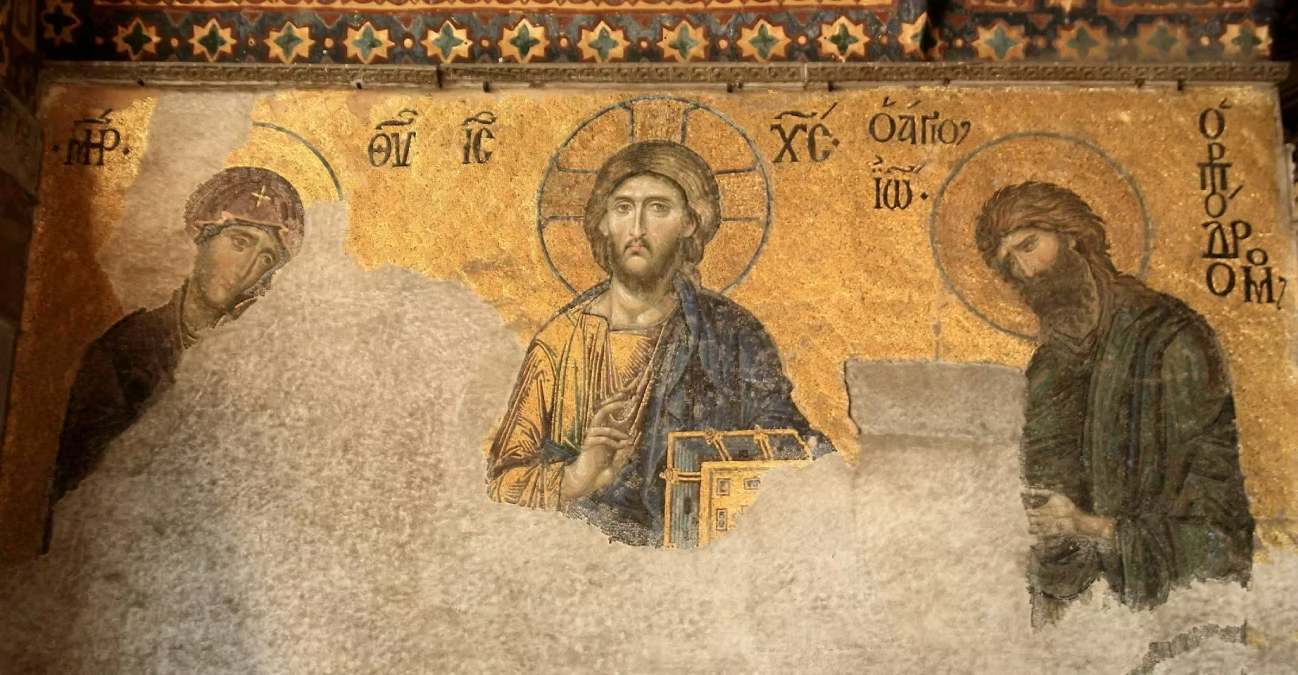
The main accessible mosaics at Hagia Sophia are located in the south gallery of the upper Visiting Area. The most celebrated is the Deesis Mosaic (c. 1261) — widely considered one of the finest surviving examples of Byzantine art. The Empress Zoe and Constantine IX panel (11th century) and the Virgin and Child apse mosaic (867 AD) are also in or visible from the gallery. Most of the original Byzantine mosaics were plastered over after the Ottoman conversion in 1453 and many were lost permanently — what survives today represents a fraction of the original decorative programme.
The mosaics of Hagia Sophia have a complicated survival story. At the height of the Byzantine Empire, the building’s interior surfaces — walls, vaults, columns, and the dome itself — were covered in gold-ground mosaics depicting Christ, the Virgin Mary, the saints, and the emperors and empresses who commissioned them. When Mehmet II converted the cathedral to a mosque in 1453, the figurative images were plastered over — not destroyed, as is sometimes claimed, but concealed. Some survived beneath that plaster for centuries. Others were lost to earthquakes, repairs, and the accumulated damage of time.
This guide covers every surviving and visible mosaic, its history, what it depicts, and exactly where to find it in the Visiting Area.
A Brief History of the Mosaics
The original Byzantine mosaic programme at Hagia Sophia began in the 6th century and continued through successive Byzantine emperors until the Ottoman conquest in 1453. During the Iconoclasm period (726–843 AD), figurative mosaics were systematically removed or plastered over by Byzantine authorities who considered religious images idolatrous. After Iconoclasm ended, new mosaics were created — the surviving examples visible today largely date from the post-Iconoclasm period (9th–13th centuries). After the Ottoman conversion in 1453, the surviving figurative mosaics were plastered over again. They began to be uncovered and studied in the 1930s during the secular museum period under Atatürk, when American scholar Thomas Whittemore led the restoration work. The 2020 reconversion to a mosque has not resulted in the re-covering of the mosaics accessible to tourists.
Key periods in mosaic history:
537 AD — Original construction: The original Justinianic decorative programme included extensive non-figurative mosaic work — geometric patterns, crosses, and abstract designs. Whether figurative mosaics were included from the outset is debated by scholars.
726–843 AD — Iconoclasm: Byzantine emperors, influenced by theological arguments against religious images, ordered the removal and destruction of figurative mosaics throughout the empire. Hagia Sophia lost much of its figurative decoration during this period.
843 AD — End of Iconoclasm: The restoration of icon veneration (the “Triumph of Orthodoxy”) was celebrated with new mosaic commissions in Hagia Sophia. The Virgin and Child apse mosaic was one of the first new figurative works installed after the Iconoclasm ended.
9th–13th centuries: The surviving figurative mosaics visible today were mostly created during this period — the patronage of successive Byzantine emperors and empresses who used the church’s most prominent surfaces to display their piety and legitimacy.
1453 — Ottoman conversion: The Ottomans plastered over the figurative mosaics to comply with Islamic prohibitions on figurative images in places of worship. The plaster paradoxically protected many mosaics from damage that would otherwise have destroyed them.
1930s — Whittemore uncovering: The American Byzantine scholar Thomas Whittemore led a systematic uncovering of the mosaics during the secular museum period, funded by the Byzantine Institute of America. The Deesis and the Zoe panel were among the mosaics revealed during this work.
2020 — Reconversion: When Hagia Sophia was reconverted to an active mosque, the government confirmed that the tourist-accessible mosaics in the upper gallery would not be re-covered. The main prayer hall below — where Muslim worshippers pray — has its figurative mosaics covered during prayer times using curtains or other temporary measures in some areas.
The Mosaics: Detailed Guide
1. The Deesis Mosaic (c. 1261)
Location: South gallery, upper level — the furthest section of the south gallery from the entrance
What it shows: Christ Pantocrator (Christ as ruler and judge of the universe) at the centre, flanked by the Virgin Mary on the left and John the Baptist on the right. Mary and John are depicted in postures of supplication — their hands slightly extended, their bodies turned slightly towards Christ — in the traditional theological arrangement known as the Deesis (Greek for “entreaty” or “prayer”), symbolising intercession for humanity.
Date and context: The mosaic dates from approximately 1261 — the year the Byzantine emperor Michael VIII Palaeologus retook Constantinople from the Latin Empire that had occupied it since the Fourth Crusade of 1204. The Palaeologan period (1261–1453) is considered a renaissance of Byzantine art, characterised by greater naturalism and psychological depth than earlier Byzantine styles, and the Deesis is one of its finest surviving examples.
What makes it exceptional: The faces — particularly the face of Christ — display a naturalism, psychological depth, and three-dimensional modelling that is rare in Byzantine art of any period. The flesh tones are rendered with subtle gradations; the hair and beard are individuated; the gaze carries genuine emotional weight. Many art historians consider it comparable to the greatest Italian painting of the same period.
What is missing: The lower third of the mosaic — the hands, lower drapery, and feet of all three figures — was lost when the gallery floor was raised during the Ottoman conversion and subsequent modifications. The surviving upper portion gives a powerful sense of the whole but is incomplete.
Practical tip: Stand as close as the barrier allows. The individual tesserae — tiny pieces of gold foil-backed glass, coloured glass, and stone — are visible at close range and reveal the extraordinary craft of the mosaic-maker. Step back for the full compositional effect; move close for the technical detail.
For a full dedicated treatment of this mosaic, see our Deesis Mosaic guide.
2. The Empress Zoe and Emperor Constantine IX Mosaic Panel (c. 1042)
Location: South gallery — adjacent to the Deesis, on the same wall but slightly closer to the entrance
What it shows: Christ enthroned at the centre, flanked by Empress Zoe of Byzantium on the right and her husband Emperor Constantine IX Monomachos on the left. Both figures are presenting offerings — Zoe a scroll, Constantine a money bag — to Christ. Above each figure, an inscription identifies them.
Why it is historically fascinating: Empress Zoe (978–1050) was one of the most remarkable figures in Byzantine history — a daughter, grand-daughter, and great-grand-daughter of Byzantine emperors who held power through three successive husbands. The mosaic was originally created to show her first husband, Romanos III. When she had him drowned in his bath and married Michael IV four days later, the mosaic was altered — Romanos’s face was chiselled out and Michael’s substituted. When Zoe’s final husband, Constantine IX, came to power, the face was replaced again. The current mosaic shows Constantine IX — but the visible irregularities in the tesserae pattern around his face and the slight discolouration where the plaster was disturbed during the alterations make the history of the changes legible to a careful observer.
What to look for: The slight variation in tesserae setting around the emperor’s face compared to the rest of the mosaic — the replacement is visible as a subtle but definite difference in texture and colour consistency.
3. The Virgin and Child Apse Mosaic (867 AD)
Location: The conch (semi-dome) above the apse at the east end of the building — visible from the gallery level but at a significant distance
What it shows: The Virgin Mary (Theotokos — God-bearer) seated on a jewelled throne, holding the Christ child on her lap. The composition is formal and frontal — the hieratic style typical of post-Iconoclasm Byzantine art, distinct from the more naturalistic approach of the later Palaiologan period.
Historical significance: This mosaic was installed in 867 AD by the Patriarch Photios to mark the end of Iconoclasm and the restoration of icon veneration. Its installation was celebrated with a formal imperial ceremony and an oration by Photios himself, which survives and includes a description of the mosaic in its original condition. It is one of the earliest datable post-Iconoclasm mosaics in Constantinople.
Practical note: This mosaic is visible from the gallery but is too distant for detailed appreciation without a zoom lens or binoculars. Its significance is primarily historical rather than visual from the viewing distance available.
4. The Dome Mosaic Fragment (Christ Pantocrator)
Location: The crown of the central dome
What it shows: A fragmentary surviving portion of what was originally a large mosaic of Christ Pantocrator. The image is faint from the gallery level — what remains is a partial figure, partially restored and partially original, visible to those who know to look for it.
Context: The original dome mosaic of Christ Pantocrator was created during the Byzantine period and covered during the Ottoman conversion. During the 1930s restoration, a partial image was revealed and stabilised. It remains visible but is the least accessible of the surviving mosaics both in terms of distance and clarity.
5. The Deësis of the Narthex (Entrance Mosaics)
The narthex (the entrance vestibule through which visitors pass before reaching the gallery) contains mosaic decoration that is partially visible on approach. The most significant is a mosaic lunette above the Imperial Door — the great bronze doors through which Byzantine emperors entered the church — showing Christ enthroned with an emperor prostrating before him (believed to be Emperor Leo VI, 9th century). This is visible from the gallery level looking back towards the entrance rather than as a stop on the main gallery circuit.
The Lost Mosaics
The surviving accessible mosaics represent a small fraction of what Hagia Sophia once contained. Lost or inaccessible mosaics include:
- Extensive Justinianic-era non-figurative and figurative decoration throughout the nave and galleries
- Many figurative panels from the middle Byzantine period
- The original Iconoclasm-era replacements (geometric and cross motifs where figurative images had been removed)
- Mosaics in areas of the building not accessible on the tourist circuit
The scale of what has been lost is a reminder that what we see today — extraordinary as it is — is a surviving remnant rather than the complete original programme.
How to See the Mosaics at Their Best
Timing: The south gallery, where the Deesis and Empress Zoe panel are located, receives relatively low and indirect light — it is one of the darker sections of the gallery. The morning light (9:00–10:00am) falls most usefully on these mosaics, creating the slight shimmer of the gold tesserae that defines the Byzantine mosaic aesthetic. See our best time to visit guide for full timing advice.
Crowds: The south gallery — particularly around the Deesis — becomes very congested during peak hours. For meaningful contemplation and photography, arriving at opening and going directly to the south gallery before crowds build is strongly recommended. See our photography guide for camera settings in low light.
Guidance: The mosaics are best understood with context. An audio guide or live guide brings the theological meaning, art historical significance, and physical survival story of each mosaic to life in ways that improve the experience significantly. See our best guided tours guide for options.
Frequently Asked Questions
How many mosaics are visible in Hagia Sophia?
The principal accessible mosaics are the Deesis (c. 1261), the Empress Zoe panel (11th century), the Virgin and Child apse mosaic (867 AD), and fragmentary dome decoration. Additional mosaic decoration is present in the narthex and transitional areas.
Why are some mosaics missing or incomplete?
Mosaics were lost during the Iconoclasm period (726–843 AD), during the Ottoman conversion (1453), and through earthquake damage and physical deterioration over 1,500 years. The plastering-over of mosaics during the Ottoman period paradoxically preserved some that would otherwise have been destroyed by structural repairs and modification.
Are the mosaics being restored?
Ongoing conservation work continues at Hagia Sophia. Some areas of the gallery may be partially screened by scaffolding during restoration work — this is a normal aspect of visiting a living monument of this age.
Were the mosaics covered when Hagia Sophia became a mosque again in 2020?
The tourist-accessible mosaics in the upper gallery were not re-covered following the 2020 reconversion. In the main prayer hall below — where worshippers pray — some figurative decoration is temporarily covered during prayer times.
