
Visiting Hagia Sophia with Kids: Complete Family Guide (2026)
Hagia Sophia is a rewarding visit for children aged approximately 8 and above, particularly with a guide or audio guide who can bring the building’s stories to life. Children under 8 enter free. Strollers are not permitted inside. The key to a successful family visit is arriving at opening (9:00am) to minimise queue times, keeping the visit to 60–75 minutes, and having a few of the building’s best stories ready to share — the Viking graffiti, the empress who changed her husband’s face, and the story of the world’s biggest dome are all genuinely compelling for curious children.
Hagia Sophia is not an obvious children’s destination — it is a 1,500-year-old mosque with Byzantine mosaics and Ottoman calligraphy, not an interactive museum or adventure playground. But it contains stories that genuinely captivate children when told well: Norse mercenaries carving their names into the gallery railings, an empress who had her husband’s face chiselled off a mosaic and replaced with a new one, a dome so large it was a miracle of engineering for a thousand years.
This guide covers what works for families, what to prepare, and how to make the visit genuinely engaging for children of different ages.
Children’s Entry: Age and Pricing
Children under 8 years old enter Hagia Sophia free of charge when accompanied by an adult. Valid proof of age (ID or passport) must be presented at the ticket kiosk when collecting entry passes. Children aged 8 and above pay the standard adult entry fee of €25. There are no separate child ticket rates for older children — the €25 fee applies from age 8 upwards.
Entry fee summary:
- Under 8: Free (ID or passport required)
- 8 and above: €25 (standard adult rate)
What to bring: A copy of the child’s passport or national ID card is sufficient proof of age at the kiosk. You do not need a printed document — a photo on your phone of the passport ID page is generally accepted.
Strollers and Pushchairs: What You Need to Know
Strollers and pushchairs are not permitted inside Hagia Sophia. The wheels can damage the historic flooring, and the mosque’s administration strictly enforces this. There are no storage facilities at the entrance for strollers.
Options for families with very young children:
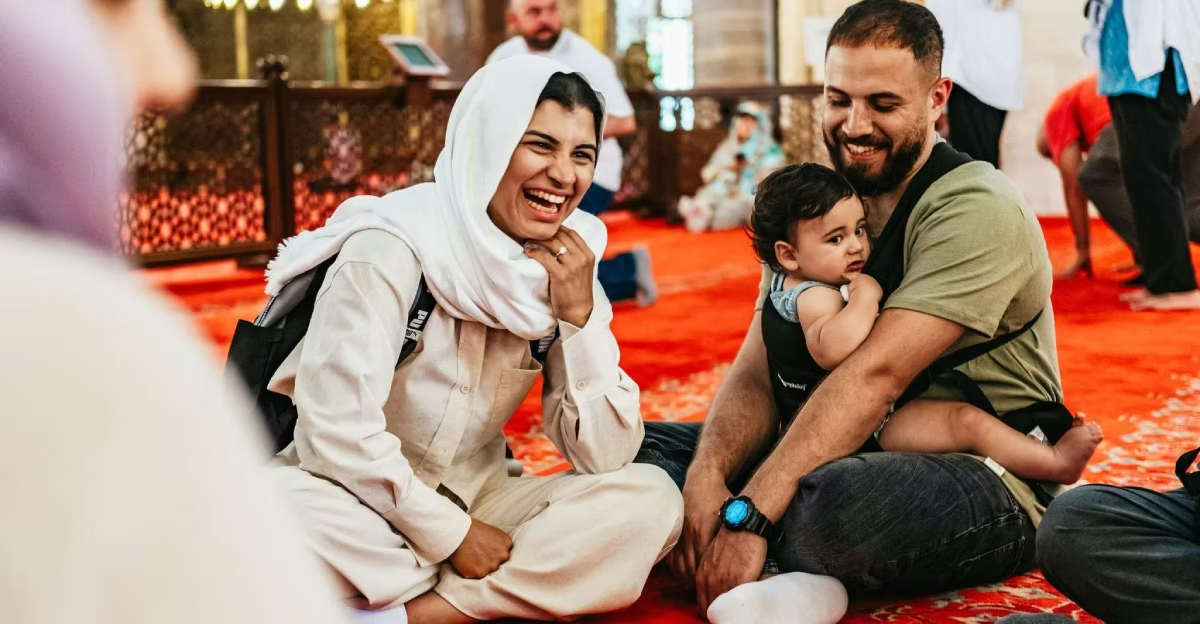
- Use a baby carrier or front carrier instead — these are permitted inside
- Leave the stroller with a non-visiting adult outside
- Fold a compact stroller and carry it in by hand (check with staff at the entrance — compact folded strollers are sometimes permitted when carried rather than wheeled)
For families with toddlers and very young children, the baby carrier is the most practical solution and allows you to move freely through the gallery.
What Children Actually Find Engaging
The success of a family visit to Hagia Sophia largely depends on whether children are given stories rather than facts. Here are the narratives that consistently work with young visitors:
The Viking graffiti
“Viking warriors carved their names into these railings over 1,000 years ago.” This lands immediately with children of almost any age. The idea that Norse warriors — the people who appear in the stories and films they know — were here, in this building, bored enough to scratch their names into the marble, makes the ancient world suddenly tangible. Point out the specific location on the balustrade and let them look for the carvings themselves.
The empress who changed her husband’s face
The Empress Zoe mosaic panel shows her husband — but his face has been chiselled off and replaced. Twice. Empress Zoe was married three times, and each time she changed husband, a new face was carved in. The evidence of the alterations is still visible in the mosaic. Children aged 7 and above find this story reliably compelling — it is historical drama at a very human scale.
The biggest dome in the world
“For almost 1,000 years, this was the biggest dome ever built. Nobody could figure out how they did it.” The central dome, viewed from the gallery, is large enough to genuinely impress children when they understand the scale. Standing at the railing and looking down into the prayer hall gives a visceral sense of height and space that most children respond to instinctively.
The building that has been everything
“This building started as a church, became a mosque, became a museum, and then became a mosque again.” The concept of a single structure changing its identity across 1,500 years of history is genuinely interesting to children who are old enough to grasp time at that scale (roughly 10 and above).
Age-by-Age Guide
Under 5 years
Young children under 5 will not engage meaningfully with the historical content but may enjoy the scale, the golden light, and the general visual drama of the space. Keep visits short — 30–45 minutes maximum. The primary challenge is the security queue, which young children find particularly draining. Arriving at 9:00am to minimise queue time is even more important with very young children.
Ages 5–7
This age group responds well to the sensory experience and to simple stories told clearly — the Viking graffiti, the golden ceiling, the “really old” building. Keep the visit focused on 2–3 highlights rather than trying to cover everything. The dome view and the Viking inscriptions are the two most reliably engaging features for this age group. Budget 45–60 minutes.
Ages 8–12
The sweet spot for Hagia Sophia family visits. Children in this age range can engage with the building’s history meaningfully, follow a live guide or audio guide, and appreciate the stories in their full complexity — the Empress Zoe drama, the Byzantine-Ottoman transition, the engineering of the dome. A guided tour with an experienced guide who knows how to pitch their commentary to mixed-age groups is ideal for this age range. Budget 60–75 minutes.
Ages 13 and above
Teenagers can engage with Hagia Sophia at an adult level and will generally find it genuinely interesting if given some preparation beforehand. Reading our history of Hagia Sophia together before the visit gives teenagers context that makes the guided commentary or audio guide significantly more rewarding.
Guided Tour vs Self-Guided: Which Is Better for Families?
For families with children aged 8–12, a live guided tour is the best option — an experienced guide who can pitch their storytelling to young visitors transforms Hagia Sophia from a beautiful old building into a genuinely captivating experience. For families with teenagers, the audio guide or a self-guided visit with preparation works well. For families with children under 8, a short self-guided visit with the key stories told by parents is usually the most practical approach.
Private guided tour: The best option for families with children of varying ages. A private guide adapts the commentary entirely to your children’s ages and interests, can slow down for younger children and go deeper for teenagers, and will know which stories to prioritise for maximum engagement. See our private guided tour review for details.
Book This TourSmall-group guided tour: A good option if a private tour is outside your budget. The group format works less well for very young children whose attention spans may disrupt the group dynamic, but is excellent for families with children aged 10 and above. See our best guided tours guide.
Audio guide: Works well for teenagers and families with children aged 10 and above who prefer to set their own pace. Less effective for younger children who cannot sustain attention through narrated commentary.
Self-guided with parental storytelling: For children under 8, often the most practical approach — keep it short, focus on the visual highlights, and use 2–3 of the key stories above to give the visit narrative shape.
Dress Code for Children
The dress code applies to all visitors including children:
- Boys must have covered shoulders and knees
- Girls must have covered shoulders, knees, and hair
In practice, enforcement for very young children (under approximately 6) may be slightly more flexible, but dressing children appropriately avoids any uncertainty at the entrance. Free headscarves are available at the entrance for girls who need them.
For full dress code details, see our dress code guide.
Timing Tips for Family Visits
Arrive at 9:00am. This is even more important for families than for solo visitors. Young children find outdoor queue time in the heat particularly draining — a long security queue before you have even entered the building can set a difficult tone for the visit. At opening, security is typically 5–15 minutes.
Keep the visit to 60–75 minutes. Young children’s engagement with a historical monument follows a predictable curve — high initial interest, sustained engagement during the key story moments, then a plateau. Planning to be done before 75 minutes means you leave while the experience is still positive rather than after it has become a battle of attention spans.
Plan the Blue Mosque for after Hagia Sophia, not before. The Blue Mosque is free and has no ticket queue — it is a lower-stakes second stop. Hagia Sophia should come first while energy levels are highest.
For full timing recommendations, see our best time to visit guide.
Practical Family Tips
Book tickets online. Children’s under-8 free entry is confirmed at the kiosk, not online — simply bring proof of age. Buy adult tickets online in advance to avoid the booth queue.
Buy This TicketBring snacks and water. Young children’s energy management in a queue and a gallery is significantly improved by snacks. A water bottle is essential in Istanbul’s warm months.
Download the audio guide before you leave. If using an audio guide, one person listening and relaying the most interesting parts to the children is more engaging than everyone trying to listen simultaneously through a single device.
Have the Viking graffiti location ready. Tell children about the Viking inscriptions before you go in — it gives them something specific to look for and creates a mini adventure within the visit.
Do not try to see everything. For families with children under 12, a focused visit covering 3–4 key highlights (the Deesis Mosaic, the Empress Zoe panel, the Viking inscriptions, the dome view) is more satisfying than an attempt to cover every feature in the gallery. Quality over quantity.
Frequently Asked Questions
What is the minimum age for visiting Hagia Sophia?
There is no minimum age — all ages are welcome. Children under 8 enter free. However, the visit is most rewarding for children aged 8 and above who can engage meaningfully with the historical content.
Are there family-friendly guided tours available?
Yes — a private guided tour with a guide experienced in working with children is the best family option. Mention your children’s ages when booking so the operator can recommend the most suitable guide. See our private tours guide for options.
Is Hagia Sophia worth visiting with young children (under 8)?
It depends on the children and the family. The visit is short enough to be manageable, free for under-8s, and the visual drama of the space does engage young children. Keep it to 45 minutes, focus on the dome views and the Viking graffiti story, and do not expect sustained historical engagement from children under 6.
Is photography allowed when visiting with children?
Yes — photography is permitted throughout the Visiting Area. Flash photography is not allowed. Children should be reminded not to photograph people who are praying.
Can I bring a baby carrier into Hagia Sophia?
Yes — baby carriers are permitted. Strollers and pushchairs are not.
