
Hagia Sophia Audio Guide: Is It Worth Getting?
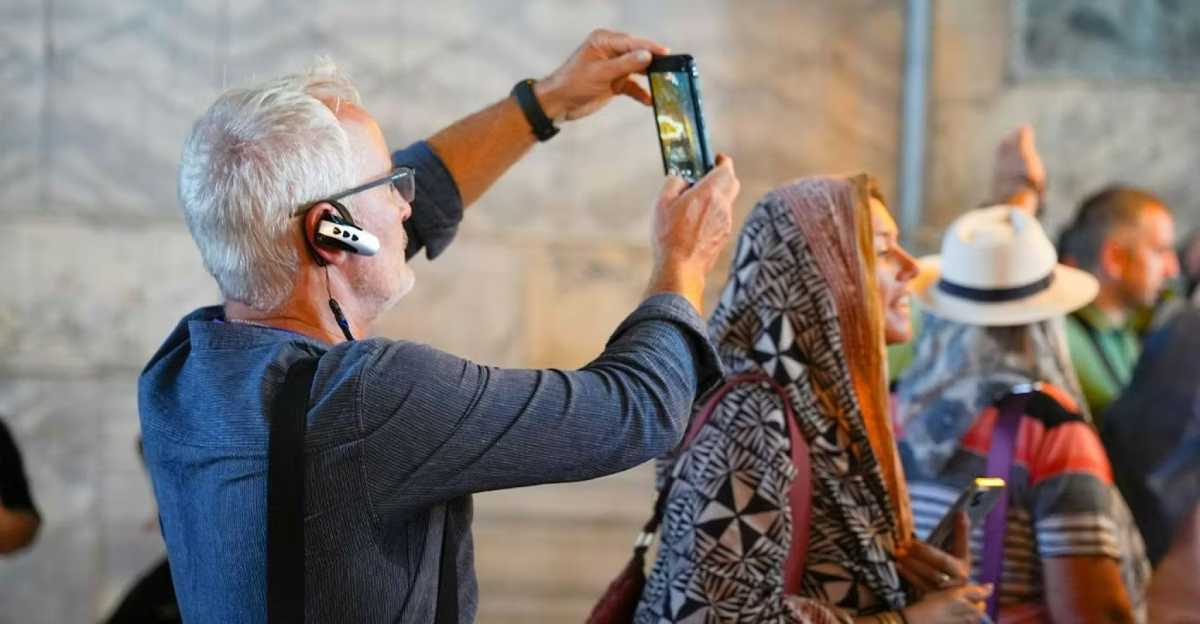
A Hagia Sophia audio guide is worth getting for most independent visitors. The upper gallery contains some of the world’s greatest Byzantine art and Ottoman decoration, but on-site interpretation is minimal — the audio guide fills that gap at a very modest cost. It is app-based, self-paced, and available in multiple languages. For visitors who want expert context without committing to a fixed group tour schedule, it is the best-value upgrade available.
Hagia Sophia’s Visiting Area — the upper gallery open to tourists — contains extraordinary works of art and architectural achievement, but almost no on-site interpretation. The Deesis Mosaic, the Empress Zoe panel, the Viking runic inscriptions carved into the balustrade — these are easy to walk past without fully understanding what you are looking at or why each one matters.
An audio guide changes that. This guide covers how the Hagia Sophia audio guide works, what it covers, which tickets include one, and how it compares to the alternatives — including the Hagia Sophia guided tour for visitors who want a live guide instead.
How Does the Hagia Sophia Audio Guide Work?
The Hagia Sophia audio guide is a smartphone-based narration app downloaded before your visit. It delivers commentary as you move through the upper gallery, covering the Byzantine mosaics, Ottoman additions, architectural features, and the building’s layered history. The guide is entirely self-paced — you pause, replay, and move freely without following a fixed schedule. It is available in multiple languages including English, German, French, Spanish, Italian, and Turkish.
The audio guide is app-based rather than a physical device collected at the entrance. When you book a ticket that includes an audio guide, you receive a download link or app access code with your booking confirmation. You install the app on your smartphone before your visit and use it throughout the upper gallery.
Key features:
- Self-paced: You control when each section plays. Pause to photograph a mosaic, replay a description, or skip ahead — the guide moves with you.
- No device collection: The guide lives on your smartphone. There is no queue to collect anything at the entrance beyond your entry QR code.
- Multi-language: Available in English, German, French, Spanish, Italian, Arabic, Russian, Turkish, and several other languages depending on the operator.
- Offline functionality: Most versions can be downloaded for offline use — recommended to avoid relying on in-gallery data connectivity.
Which Tickets Include an Audio Guide?
Not all Hagia Sophia tickets include an audio guide. Here is how the current options break down:
| Ticket | Audio Guide Included |
|---|---|
| Self-guided skip-the-line entry | No |
| Mosque + History Museum combo | Yes |
| Hagia Sophia Guided Tour (t609331) | Varies — check at booking |
| Private guided tour | Guide provides live narration |
| Combo tickets (Blue Mosque, Cistern etc.) | Yes — at most sites |
If you want a standalone entry ticket with an audio guide, look for the mosque + museum combo which bundles both, or confirm audio guide inclusion at the point of booking for whichever ticket you choose.
For a full comparison of all ticket types, see our Hagia Sophia tickets overview, or book directly via the official Hagia Sophia website.
What Does the Audio Guide Cover?
The Hagia Sophia audio guide covers the major features of the upper gallery Visiting Area, including the Deesis Mosaic (c. 1261), the Empress Zoe mosaic panel, the Virgin and Child apse mosaic, Viking runic inscriptions, the 31-metre central dome, and the Ottoman calligraphic medallions. It also narrates the building’s 1,500-year history — from its construction under Justinian I in 537 AD through the Ottoman conquest, secular museum period, and 2020 reconversion to a mosque.
A typical audio guide sequence through the upper gallery covers:
Historical overview: A brief introduction to Hagia Sophia’s significance — the largest cathedral in the world for nearly a thousand years, converted to a mosque in 1453, then a museum, then a mosque again.
The central dome: The engineering achievement of the 31-metre dome — how it is supported by pendentives rather than a solid drum, and how it has survived earthquake damage over 15 centuries.
The Deesis Mosaic: The audio guide’s centrepiece. Coverage of the mosaic’s date (c. 1261), its theological significance (Christ flanked by the Virgin and John the Baptist in an act of intercession), why parts were plastered over during the Ottoman period, and why the lower sections are missing. The technical mastery of the gold and glass tesserae is typically highlighted.
The Empress Zoe mosaic panel: The guide explains how Empress Zoe’s successive husbands’ faces were literally chiselled off and replaced as her marital situation changed — and points out where the alterations remain visible.
The Virgin and Child apse mosaic: Visible from the gallery looking towards the main apse — one of the first post-Iconoclasm mosaic restorations in the 9th century.
Viking runic inscriptions: The guide identifies the location of carvings made by the Varangian Guard — Norse mercenaries in Byzantine service — and explains what the legible inscriptions say.
Ottoman additions: Commentary on the calligraphic medallions, mihrab, and minbar visible from the gallery, and how the Ottomans approached the existing Byzantine decoration after 1453.
Audio Guide vs Live Guided Tour: Which Is Better?
A live guided tour offers a richer experience than an audio guide — guides adapt commentary to your interests, answer questions in real time, and draw connections the audio guide cannot make dynamically. Audio guides offer more flexibility (no fixed schedule or group pace) and cost significantly less. For independent travellers, the audio guide is the better-value option. For first-time visitors, families, or groups wanting maximum understanding, a live tour is worth the premium.
| Factor | Audio Guide | Live Guided Tour |
|---|---|---|
| Cost above base entry | Minimal (often bundled) | €30–€60+ per person |
| Flexibility | Complete — fully self-paced | Group or guide sets the pace |
| Depth of commentary | Good — covers all key features | Excellent — adaptable, interactive |
| Questions answered | No | Yes |
| Best for | Independent travellers | Families, first-timers, history enthusiasts |
If you want a live guided experience, the Hagia Sophia Guided Tour is the most popular option. For a private experience, see our private guided tour review. For a full comparison of all guided formats, see our best guided tours guide.
Is the Audio Guide Worth It?
For most independent visitors, yes. The upper gallery has minimal on-site signage — without narration, even well-travelled visitors often miss the significance of what they are looking at. The audio guide is the lowest-cost way to ensure your visit is genuinely informative rather than just visually impressive.
The audio guide is particularly good value for:
Solo travellers and couples who want depth without the social commitment of a group tour. Repeat visitors who did a self-guided visit previously and want a richer second experience. Budget-conscious visitors who want historical context without the cost of a live guide.
The audio guide is less useful for:
Visitors who have done extensive prior reading and already know the story of every mosaic in detail. Young children, who are unlikely to engage with narrated commentary — a live guide who adapts their communication style is a better choice for families with young kids.
Practical Tips for Using the Audio Guide
Download the app before you arrive. Do not assume you will have reliable data inside the building. Download all audio content while on Wi-Fi the night before your visit.
Bring headphones. The upper gallery has ambient noise — other visitors, the occasional call to prayer from nearby mosques. Headphones make the narration significantly easier to follow.
Charge your phone fully. A full audio guide session runs 60–90 minutes of active listening. Bring a portable charger if battery life is a concern.
Follow the guide’s suggested route. The stops are sequenced to move logically through the gallery and approach each feature from the best vantage point.
Time your arrival carefully. The audio guide experience is most enjoyable when the gallery is quieter. Arriving before 10:00am or after 4:30pm makes a noticeable difference. See our best time to visit Hagia Sophia guide for full crowd pattern detail.
Frequently Asked Questions
Is the audio guide available in my language?
Most operators offer audio guides in English, German, French, Spanish, Italian, Arabic, Russian, and Turkish. Check the specific ticket listing for a current language list before booking.
Do I need to collect anything at the entrance?
No — the audio guide is entirely app-based. Your only collection step is having your entry QR code scanned at the History Museum kiosk before proceeding to the mosque.
Can I use the audio guide offline?
Most versions can be downloaded for offline use. Download the content on Wi-Fi before your visit.
Is the audio guide suitable for children?
The standard audio guide is written for an adult audience. Children aged 10 and above can typically engage with it. For younger children, a live guided tour with an experienced guide is a better option.
How long does the audio guide take?
A full session covering all stops typically runs 60–90 minutes. Your entry ticket is not time-limited — you can stay in the gallery as long as you like after the guide finishes.
Can I replay sections?
Yes — the app is fully interactive. You can pause, replay any section, and return to earlier stops as many times as you like during your visit.
