
The Upper Gallery at Hagia Sophia: A Complete Visitor Guide
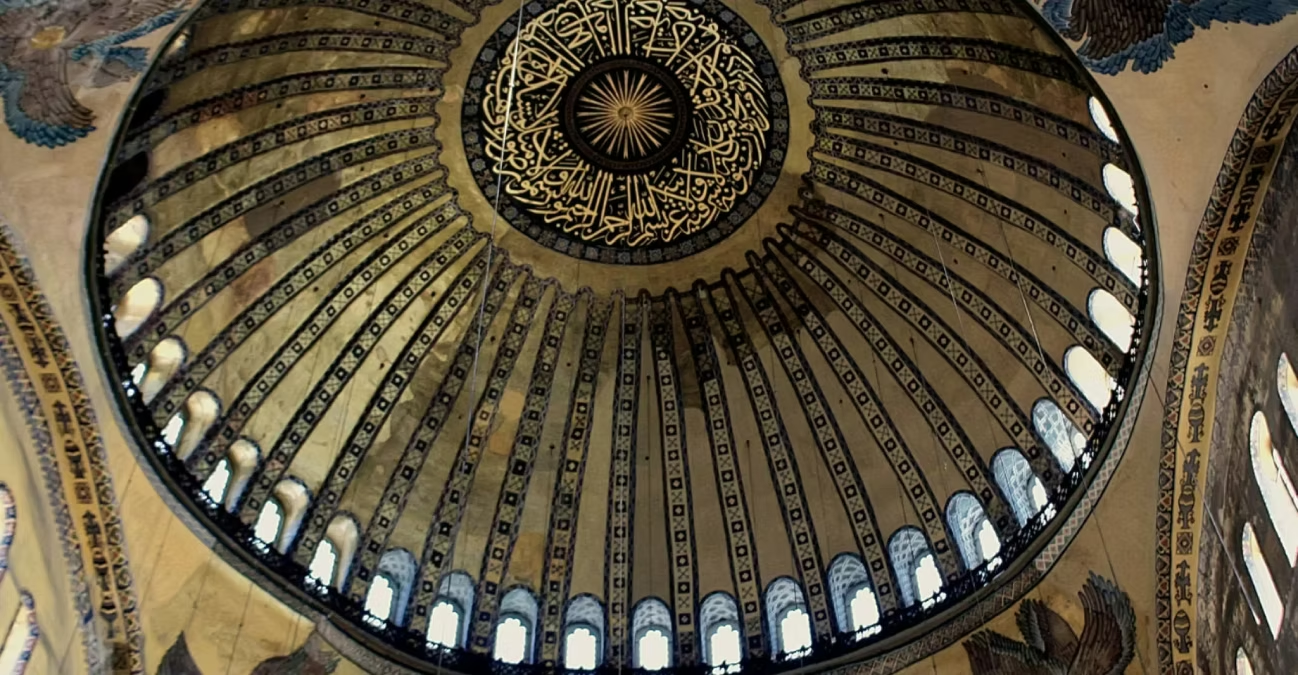
The upper gallery is the entire tourist Visiting Area at Hagia Sophia in 2026 — all foreign tourists are directed to the upper gallery via the dedicated tourist entrance near Topkapi Palace. It contains the Deesis Mosaic, the Empress Zoe panel, the Viking runic inscriptions, and panoramic views of the central dome and prayer hall. It is absolutely worth visiting — it is where all the famous Byzantine mosaics are located.
Since 2024, all foreign tourist access to Hagia Sophia has been channelled through the upper gallery — the elevated circuit around the main nave that was historically used by women, the imperial court, and the clergy during Byzantine services. The ground floor prayer hall is reserved for Muslim worshippers. Understanding this distinction matters because many visitors arrive expecting to walk through the famous interior at ground level, as they could during the museum period, and are sometimes surprised to find that their experience is elevated and gallery-based rather than ground-floor.
This guide explains exactly what the upper gallery is, what it contains, and what to expect from the visit.
What Is the Upper Gallery?
The upper gallery of Hagia Sophia is the elevated circuit around the perimeter of the main nave, situated approximately 7 metres above the prayer hall floor. In the Byzantine period, the galleries were used by women, the imperial court, and the choir. Today, the upper gallery — accessed via a ramp from the northeast tourist entrance — is the Visiting Area open to all foreign tourists. It contains the principal surviving Byzantine mosaics and offers elevated views of the 31-metre central dome and the prayer hall below.
The upper gallery was a fundamental part of the original Justinianic design — it was not an afterthought or a secondary space but an integral part of the building’s function. In Byzantine liturgical practice, the galleries served different social groups simultaneously: women worshipped separately from men, the empress and her court occupied the imperial loge, and the choir performed from elevated positions that allowed their singing to fill the entire space.
The gallery is U-shaped in plan — a north gallery, a south gallery, and a central section connecting them along the main axis of the building. The south gallery is the most historically and artistically significant section, containing all three of the major accessible Byzantine mosaic panels.
How Tourists Access the Upper Gallery
Foreign tourists access the Hagia Sophia upper gallery via a dedicated tourist entrance on the northeast side of the building, near the Topkapi Palace gate. This entrance — introduced as part of the 2024 ticketing restructuring — provides access via a gentle ramp that leads directly to the upper gallery level. Tickets are collected at the Hagia Sophia History and Experience Museum kiosk before proceeding to the tourist entrance. The tourist entrance is separate from the main entrance used by Muslim worshippers accessing the ground-floor prayer hall.
Step by step:
- Collect entry pass from the History and Experience Museum kiosk (At Meydanı No:10) — this is where your QR code is scanned
- Walk to the tourist entrance on the northeast side of the building (follow Visiting Area signs — approximately 3 minutes from the kiosk)
- Join the security queue — mandatory for all visitors; takes 5–30 minutes depending on time of day
- Ascend the ramp to the upper gallery level
- Follow the gallery circuit — north gallery, central walkway, south gallery — and exit via the same route or a designated exit
Important: The tourist entrance is not the main gate facing Sultanahmet Square. The main gate is the entrance for Muslim worshippers accessing the prayer hall. Follow the signs for “Visiting Area” from the Sultanahmet tram stop — they direct you to the northeast side of the building.
What to See in the Upper Gallery
The upper gallery contains every significant feature accessible to tourists. A thorough visit covers:
The Deesis Mosaic (South Gallery)
The centrepiece of the Visiting Area and one of the greatest surviving works of Byzantine art. Dating from approximately 1261 AD, it depicts Christ Pantocrator flanked by the Virgin Mary and John the Baptist in an intercessory composition of extraordinary psychological depth and artistic quality. The gold and glass tesserae, set at deliberate angles to catch and reflect ambient light, create a shimmering luminosity that photographs only partially convey.
Allow 10–20 minutes here. Position yourself close enough to see the individual tesserae; step back for the full compositional impact. For full context, see our dedicated Deesis Mosaic guide.
The Empress Zoe and Constantine IX Mosaic Panel (South Gallery)
The 11th-century mosaic depicting Empress Zoe of Byzantium and her husband making an offering to Christ — notable for the visible evidence of successive face replacements as Zoe’s three husbands were represented and then revised in the panel. The altered areas around the emperor’s face are legible to careful observation. See our mosaics guide for full context.
The Viking Runic Inscriptions (South Gallery Balustrade)
Small carvings in the marble balustrade made by members of the Varangian Guard — Norse mercenaries in Byzantine service. Easy to miss without guidance. The most legible inscription reads approximately “Halfdan carved these runes.” Ask your guide or audio guide to point you directly to the location.
Dome and Prayer Hall Views (Central Walkway)
The upper gallery offers the best elevated perspective on the 31-metre central dome and the main prayer hall below. From the central walkway, you can see the ring of 40 windows at the dome’s base, the Ottoman calligraphic medallions (each 7.5 metres in diameter), and the full spatial drama of the interior. The views down into the prayer hall — the carpets, the mihrab, the chandelier system — give a strong sense of the building’s scale.
The Virgin and Child Apse Mosaic (Visible from Gallery)
Visible at a distance from the south gallery, looking across the nave towards the main apse. The 9th-century mosaic depicting the Virgin Mary holding the Christ child is too distant for detailed appreciation without a telephoto lens or binoculars, but its presence reinforces the richness of the original decorative programme.
The Column Systems and Marble Revetments
The gallery is lined with marble revetments — thin panels of polychrome stone applied to the walls — and supported by column arcades. The columns are spolia (reused ancient columns from earlier buildings) selected for size and visual effect. The variety of marble types — green, red, white, yellow — creates a rich chromatic environment that reflects the building’s intentionally cosmopolitan material sourcing from across the Byzantine world.
The Imperial Loge
In the south gallery, at the centre of the south wall, a raised section of the gallery floor marks the position of the imperial loge — the space from which the Byzantine empress and her court attended services, separated from both the main congregation below and the general gallery visitors around them. A low marble barrier defines the space. This is the area where the Deesis Mosaic and the Empress Zoe panel are located — their proximity to the imperial loge is not coincidental. These were images commissioned for and visible primarily to the imperial court.
The Experience of the Upper Gallery
The upper gallery creates a distinctive experience — you are elevated above the prayer hall rather than within it, looking down on the central space rather than being immersed in it. This can feel surprising to visitors who have seen photographs of the main interior and expected to be standing on the floor beneath the dome.
In practice, the elevated perspective has its own qualities:
The dome reads better from the gallery. Looking up at the dome from ground level, the angles are extreme and the perspective distorted. From the gallery, you are at a height where the dome’s geometry — the pendentives, the window ring, the curvature — is more legible and more comprehensible.
The mosaics are at eye level. The Deesis and the Empress Zoe panel are in the south gallery wall at approximately eye height — you look at them directly rather than craning upwards. This is the ideal way to appreciate Byzantine mosaic art.
The spatial drama is immersive. Standing at the gallery railing and looking down into the prayer hall, then up at the dome, creates a visceral experience of the building’s scale that ground-floor visitors in the museum era often described as overwhelming.
Is the Upper Gallery Enough to Justify the Visit?
Yes — absolutely. The upper gallery contains all of Hagia Sophia’s principal tourist attractions: the Deesis Mosaic (one of the world’s great works of Byzantine art), the Empress Zoe panel, the Viking inscriptions, and panoramic views of the interior. The restriction of tourist access to the upper gallery, rather than the ground floor, does not materially diminish the experience — for most visitors, the elevated perspective is as rewarding as ground-floor access was during the museum period.
Some visitors who visited during the free museum period (before 2024) feel that the gallery-only access is a lesser experience than walking the ground floor. For first-time visitors, however, the upper gallery provides a complete and deeply rewarding visit — the mosaics alone, particularly the Deesis, justify the visit without reference to what is or is not accessible below.
Practical Tips for the Upper Gallery Visit
Arrive at 9:00am. The south gallery — where the Deesis and Empress Zoe panel are — becomes crowded by 10:30am in peak season. Early arrival means unobstructed views and the best morning light on the mosaics. See our best time to visit guide.
Go to the south gallery first. The audio guide and most live guides follow a standard sequence. If you are visiting independently, consider going directly to the south gallery as your first stop — before crowds build — and then working back through the rest of the circuit.
Disable your camera flash before entering. Flash photography is not permitted and is actively monitored. Disable it before you reach the gallery to avoid any disruption.
Bring headphones for the audio guide. The gallery has ambient noise from other visitors. Headphones make the audio narration significantly easier to follow.
Allow 60–90 minutes. A thorough visit to the upper gallery circuit takes 60–90 minutes. See our how long guide for time estimates by visit type.
Frequently Asked Questions
Can tourists visit the ground floor of Hagia Sophia?
No — the ground-floor prayer hall is reserved for Muslim worshippers and is not accessible to tourists. All tourist access is through the upper gallery Visiting Area.
Was it different when Hagia Sophia was a museum?
Yes — during the museum period (1934–2020), tourists walked through the ground floor and could appreciate the interior from ground level. Since the 2020 reconversion and the 2024 ticketing restructuring, tourist access is limited to the upper gallery.
Is the upper gallery the same as the Visiting Area?
Yes — “Visiting Area” and “upper gallery” refer to the same tourist-accessible space. The terms are used interchangeably.
Are there stairs in the upper gallery?
The access ramp from the tourist entrance is step-free. Inside the gallery itself, the circuit is largely on a single level, though some sections have uneven ancient marble flooring. See our accessibility guide for full details.
How long does the upper gallery take to visit?
60–90 minutes for a thorough self-guided visit with audio guide. Guided tours inside the gallery run approximately 60–75 minutes. See our how long guide.
