
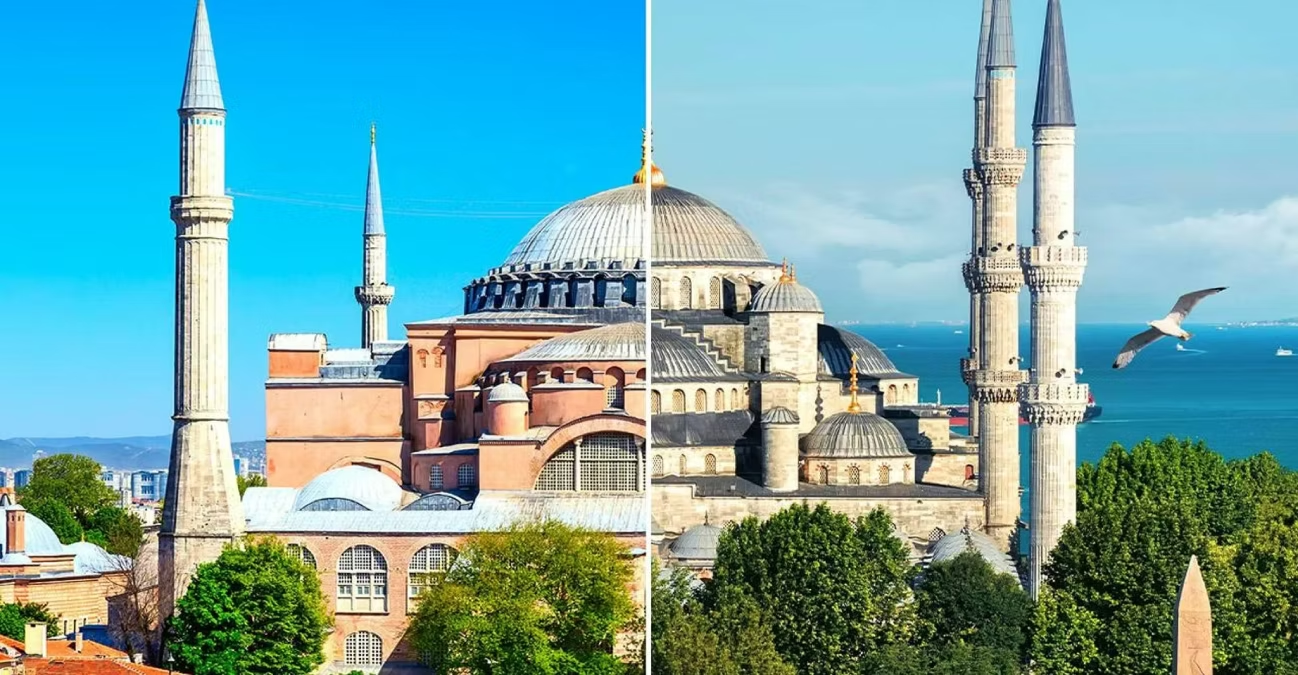
Hagia Sophia vs Blue Mosque: Which Should You Visit First?

Visit Hagia Sophia first, then the Blue Mosque. Hagia Sophia requires a paid ticket (€25), has skip-the-line considerations, and contains the primary artistic highlights (Byzantine mosaics). The Blue Mosque is free and has no ticket queue. Starting with Hagia Sophia ensures you secure entry to the ticketed attraction before potential sell-outs or queue complications, and the Blue Mosque’s architectural dialogue with Hagia Sophia is more legible when you have already seen what it was responding to.
Hagia Sophia and the Blue Mosque are the two most visited monuments in Istanbul’s Sultanahmet district, standing directly opposite each other across what was once the Byzantine Hippodrome. They are often visited on the same day — and often compared. But they are very different experiences, built in different eras for different purposes, and understanding what makes each one distinctive enriches both visits.
This guide compares the two buildings honestly, explains what each offers, and advises on the practical question of order and combination.
The Basic Facts: Side by Side
Hagia Sophia (Ayasofya) was built in 537 AD as a Byzantine Christian cathedral and is now an active mosque. Entry for tourists costs €25 and is limited to the upper gallery. The Blue Mosque (Sultan Ahmed Mosque) was built in 1616 as an Ottoman imperial mosque and remains in continuous use. It is free to enter for all visitors. Both are in Istanbul’s Sultanahmet district, approximately 300 metres apart. Both have active mosque status and enforce a dress code. The Blue Mosque has six minarets; Hagia Sophia has four.
| Feature | Hagia Sophia | Blue Mosque |
|---|---|---|
| Built | 537 AD (Byzantine) | 1616 AD (Ottoman) |
| Original purpose | Christian cathedral | Imperial mosque |
| Current status | Active mosque | Active mosque |
| Entry fee | €25 (tourists) | Free |
| Tourist access | Upper gallery only | Main prayer hall (entry corridor) |
| Minarets | 4 | 6 |
| Dome diameter | 31.24 metres | 23.5 metres |
| Key features | Byzantine mosaics, engineering, history | Iznik tiles, six minarets, Ottoman proportions |
| Best for | Art history, architectural engineering, layered history | Pure Ottoman architecture, atmospheric interior, free visit |
| Time needed | 60–90 minutes | 40–60 minutes |
| Dress code | Required | Required |
What Makes Each One Unique
What Hagia Sophia Offers
Unmatched historical depth. Hagia Sophia has been continuously significant for nearly 1,500 years. It was a Byzantine cathedral, an Ottoman imperial mosque, a secular museum, and is now a mosque once again. The layers of history are physically visible in the building — Byzantine mosaics and Ottoman calligraphy in the same space, a mihrab slightly offset from the altar axis, Viking graffiti on the gallery railings.
The Deesis Mosaic. One of the greatest surviving works of Byzantine art, and an experience that is simply not available anywhere else in the world. No other building accessible to tourists has anything quite like it.
Architectural innovation. The dome, the pendentives, the window system — Hagia Sophia represents one of the most ambitious structural achievements in architectural history. Understanding how it was built is part of the experience.
A sense of age. Hagia Sophia feels ancient in a way that the Blue Mosque, for all its grandeur, does not. Standing in the south gallery looking at the Deesis, you are in the presence of an object that was made over 760 years ago in a building that was already 724 years old when it was made.
What the Blue Mosque Offers
The Iznik tiles. The Blue Mosque’s interior is dominated by over 20,000 hand-painted Iznik tiles — ceramic panels of extraordinary quality covering the walls from the gallery level down. The dominant blue-green tones of the tiles in combination with the natural light from 260 windows create an interior atmosphere of remarkable serenity and beauty. Nothing in Hagia Sophia quite matches this specific sensory experience.
Six minarets. The Blue Mosque is one of only two mosques in Turkey (and among very few in the world) with six minarets. From Sultanahmet Square, the silhouette with its six minarets and cascading domes is one of the defining images of Istanbul.
Free entry. The Blue Mosque charges no entry fee — it is an active place of worship open to all visitors who comply with the dress code. This makes it the more accessible of the two for visitors on a budget.
Classical Ottoman proportions. The Blue Mosque represents the mature phase of Ottoman mosque design — a tradition that developed over 150 years after the Ottoman conversion of Hagia Sophia, refining and systematising the structural and spatial lessons of Byzantine architecture into a distinctly Ottoman idiom.
The courtyard. The Blue Mosque has a large, photogenic outer courtyard that Hagia Sophia lacks — a colonnaded space that provides a transitional zone between the street and the mosque interior, and an excellent photography location.
The Architectural Dialogue Between Them
The Blue Mosque was built by Sultan Ahmed I (1603–1617) in direct architectural response to Hagia Sophia, which stood immediately opposite. Ahmed wanted a mosque that could compete with Hagia Sophia in scale and prestige — the six minarets were controversially ambitious, the dome system (23.5 metres, surrounded by four half-domes) explicitly echoes Hagia Sophia’s structural logic, and the use of galleries and windows to flood the interior with light repeats Hagia Sophia’s defining aesthetic strategy. Visiting both buildings sequentially makes this dialogue explicit in a way that visiting either one alone cannot.
The comparison that most clearly illustrates the dialogue: stand in the upper gallery of Hagia Sophia and look at the dome. Then stand in the Blue Mosque and look at its dome. The structural logic — central dome, half-domes, cascading conches, a ring of windows — is recognisably related. The Ottoman architects were not copying; they were responding, refining, and asserting their own tradition’s mastery of a structural and aesthetic model that Hagia Sophia had defined a thousand years earlier.
Which Is “Better”?
This is not a useful question — the two buildings are doing fundamentally different things and excel in different ways. But a more useful framing:
Hagia Sophia is better if you are interested in: Art history (the Byzantine mosaics), architectural history (the engineering innovation of the dome), layered political and religious history, or the experience of a building that carries multiple civilisations in its fabric simultaneously.
The Blue Mosque is better if you are interested in: Classical Ottoman architecture at its most refined, the specific sensory experience of the Iznik tile interior, a free and unmediated encounter with an active mosque, or the experience of a building that achieves its effect through harmony and proportion rather than historical complexity.
For most first-time visitors, the honest answer is: Hagia Sophia is more significant and Hagia Sophia is more complex. The Blue Mosque is more immediately beautiful and more serene. Both deserve your attention.
Which to Visit First: Practical Recommendation
Visit Hagia Sophia first for the following reasons:
It requires a ticket. Booking your Hagia Sophia entry online in advance is strongly recommended. Visiting Hagia Sophia first in the day — when your ticket is booked and the security queue is shortest — reduces logistics stress. The Blue Mosque is free and has no ticket queue, so it can be visited flexibly at any point during your day.
The context works in your favour. If you have seen Hagia Sophia first — its Byzantine mosaics, its dome system, its historical layers — the Blue Mosque’s architectural dialogue with it becomes immediately legible when you cross Sultanahmet Square. The six minarets, the dome, the tile programme — all of it makes more sense as a response to what you have just seen.
Hagia Sophia’s morning light is better. The Hagia Sophia south gallery (where the mosaics are) receives its best light in the morning hours. The Blue Mosque’s interior is broadly lit throughout the day — the white and blue tile palette performs consistently regardless of the time.
Practical sequence:
- 9:00am: Hagia Sophia (60–90 minutes)
- 10:30am: Walk 3 minutes across Sultanahmet Square to the Blue Mosque
- 10:30–11:30am: Blue Mosque (40–60 minutes)
- Done before noon with both major Sultanahmet mosques completed
Combo Tickets and Tours
If you are visiting both on the same day — which most Sultanahmet visitors do — a combo ticket or guided tour is the most practical booking approach.
Self-guided combo: Hagia Sophia + Blue Mosque combo ticket — audio guides at both, single booking.
Buy This TicketGuided tour: Guided tour of Hagia Sophia and Blue Mosque — a guide leads both visits with expert commentary on the architectural dialogue between them.
Book This TourDress Code Reminder
Both buildings are active mosques with identical dress code requirements: covered shoulders, covered knees, and covered hair for women. Free headscarves are available at both entrances. Dressing appropriately before leaving your hotel means no delays at either entrance. See our dress code guide for details.
Frequently Asked Questions
Can I visit both Hagia Sophia and the Blue Mosque in one morning?
Yes comfortably — they are 300 metres apart and together require 2–2.5 hours. Start at Hagia Sophia at 9:00am and you will be done with both before noon.
Is the Blue Mosque better than Hagia Sophia?
Neither is objectively better — they excel in different ways. Hagia Sophia has greater historical depth and the Byzantine mosaics; the Blue Mosque has the Iznik tile interior and free admission. Most visitors find Hagia Sophia the more significant experience; many find the Blue Mosque the more immediately beautiful.
Do I need to book the Blue Mosque in advance?
No — the Blue Mosque is free and has no advance booking requirement. Just show up during visiting hours, dressed appropriately.
Is the Blue Mosque open during Hagia Sophia’s Friday closure?
Yes — the Blue Mosque has its own prayer schedule and does not observe the same tourist closure times as Hagia Sophia. The Friday midday closure (12:30–14:30) applies only to Hagia Sophia’s Visiting Area. If you arrive at Hagia Sophia during this closure, the Blue Mosque is a natural alternative for the waiting period.
Which has a better view of Istanbul?
Neither building offers a high external viewpoint — both are experienced from inside. For panoramic Istanbul views, the Galata Tower is the most popular option. See our Dolmabahce + Hagia Sophia + Galata Tower combo guide for how to include the Galata Tower in a broader day.
