
Hagia Sophia: Frequently Asked Questions (2026)
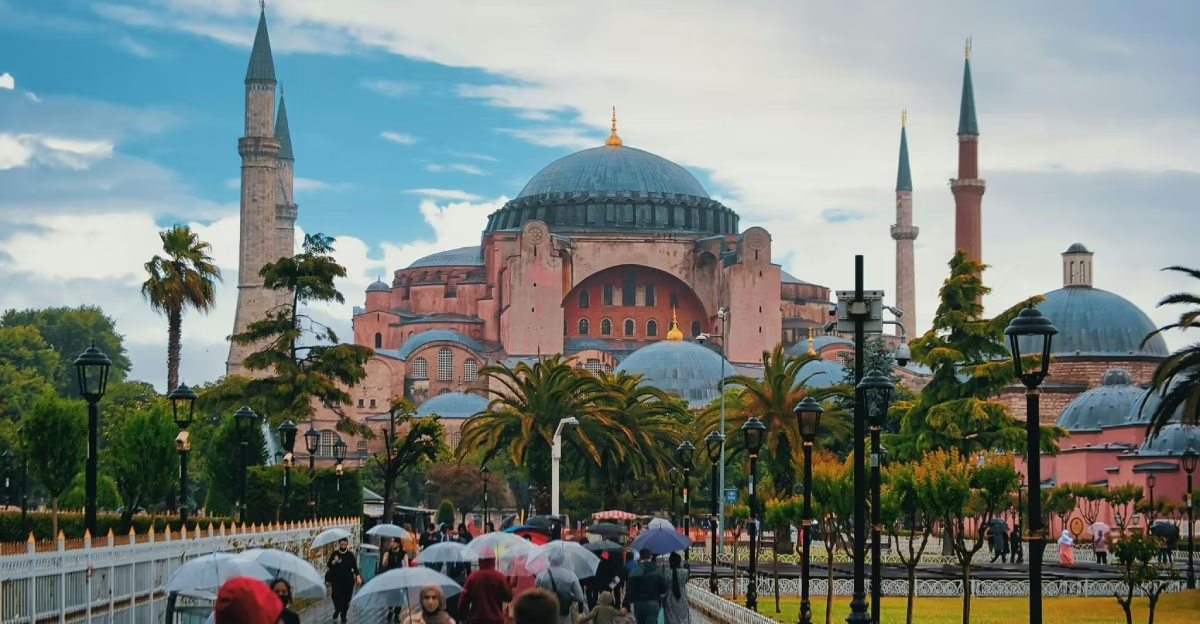
Hagia Sophia is an active mosque open to tourists daily from 9:00am to 7:30pm (last entry 7:00pm). Entry costs €25 for foreign tourists. Tourists visit the upper gallery only — the ground floor is reserved for Muslim worshippers. The Istanbul Museum Pass is not valid. Children under 8 enter free. The Friday midday closure (12:30–14:30) is the single most important planning detail for visitors.
This page brings together answers to every question visitors commonly ask about Hagia Sophia before and during their visit — covering tickets, opening hours, the dress code, what you can and cannot see, how to get there, accessibility, photography, and what has changed since the 2024 ticketing restructuring.
Tickets & Entry
How much does Hagia Sophia cost to enter in 2026?
The entry fee for foreign tourists is €25. This applies to all nationalities. The fee was introduced in January 2024 — before this date, Hagia Sophia was free to enter. Children under 8 enter free with a valid ID or passport. See our ticket prices guide for a full breakdown of all options.
Is the Istanbul Museum Pass valid at Hagia Sophia?
No. Hagia Sophia operates its own separate ticketing system and is not covered by the Istanbul Museum Pass (Müzekart), the Pass Istanbul, or any standard city museum card. You must purchase a dedicated Hagia Sophia ticket.
Does the Istanbul Tourist Pass include Hagia Sophia?
The Istanbul Tourist Pass (a private commercial pass sold online) includes Hagia Sophia in certain tiers. This is different from the government-issued Museum Pass. Always confirm Hagia Sophia inclusion for the specific tier you are purchasing before booking. See our Istanbul Tourist Pass guide.
Do I need to book in advance?
It is strongly recommended, particularly between April and October. Online tickets bypass the ticket booth queue — which runs 45–90 minutes during peak season — and deliver your QR code in advance. Booking at least 24 hours ahead ensures your code arrives before your visit. See our skip-the-line guide for full detail.
Where do I collect my online ticket?
Online tickets are collected at the Hagia Sophia History and Experience Museum kiosk, located at Binbirdirek Mahallesi, At Meydanı No:10, Fatih — a 2–3 minute walk from the tourist entrance. You present your QR code at the kiosk and receive your physical entry pass before proceeding to the mosque entrance.
Are tickets refundable?
Most online tickets include free cancellation up to 24 hours before your visit date. Check the specific product page for the cancellation policy before booking.
Do children pay to enter?
Children under 8 enter free with valid proof of age (ID or passport). Children aged 8 and above pay the standard adult fee of €25.
Is there a discount for students or seniors?
There are no widely available student, senior, or group discount rates for the standard entry fee. Combination and combo tickets can offer better per-attraction value if visiting multiple Sultanahmet landmarks. See our ticket comparison guide.
Can I buy tickets at the door?
Yes — tickets are available at the on-site booth. However, during peak season booth queues of 45–90 minutes are common. Buying online in advance is strongly recommended.
Opening Hours & Schedule
What are Hagia Sophia’s opening hours in 2026?
The Visiting Area (upper gallery) is open daily from 9:00am to 7:30pm, with last entry at 7:00pm. The Hagia Sophia History and Experience Museum is open daily from 9:00am to 8:00pm (last entry 7:00pm). See our opening hours guide for full details including seasonal notes.
Is Hagia Sophia open on Fridays?
Yes — but the Visiting Area closes to tourists between 12:30 and 14:30 every Friday for the congregational midday prayer. The building is open to tourists 9:00am–12:30pm and again from 14:30–7:30pm on Fridays. This is the single most important scheduling detail for visitors planning a Friday trip.
Is Hagia Sophia open every day of the year?
Yes — Hagia Sophia is open seven days a week, including weekends and Turkish public holidays. The only regular tourist closure is the Friday midday prayer window (12:30–14:30).
What is the last entry time?
Last entry to the Visiting Area is at 7:00pm — 30 minutes before the 7:30pm closing time. Arrive before this or you will not be admitted.
Does Hagia Sophia close during prayer times on other days?
The five daily prayers take place at Hagia Sophia throughout the week. On all days except Friday, the Visiting Area does not close during these prayer times — tourist and worship functions operate simultaneously with separate access routes. Only the Friday midday prayer results in a full tourist closure.
Is Hagia Sophia open during Ramadan?
Yes — standard visiting hours apply throughout the Ramadan period.
What You Can See
Can tourists visit the ground floor of Hagia Sophia?
No — as of 2024, the ground-floor prayer hall is reserved exclusively for Muslim worshippers. All foreign tourists access only the upper gallery (Visiting Area) via the dedicated tourist entrance. This is a permanent arrangement, not a temporary measure.
What is in the upper gallery?
The upper gallery contains the principal Byzantine mosaics — including the Deesis Mosaic (c. 1261), the Empress Zoe and Constantine IX panel (11th century), and the Virgin and Child apse mosaic (867 AD). It also offers panoramic views of the 31-metre central dome and the prayer hall below, and the Viking runic inscriptions carved by the Varangian Guard are located on the south gallery balustrade. See our what to see inside guide for a complete feature-by-feature breakdown.
Can I see the famous mosaics?
Yes — the main accessible Byzantine mosaics are in the south gallery of the upper Visiting Area. The Deesis Mosaic is the most celebrated and is at approximately eye height in the south gallery. See our mosaics guide.
Can tourists visit the minarets?
No — the minarets are not open to tourist visitors.
What happened to the ground-floor access that was available during the museum period?
Between 1934 and 2020, when Hagia Sophia operated as a secular museum, tourists walked through the ground-floor space beneath the central dome. Since the 2020 reconversion to an active mosque and the 2024 ticketing restructuring, tourist access is limited to the upper gallery. The ground floor is the active prayer hall and is used for worship throughout the day.
How long does a visit take?
A thorough self-guided visit to the upper gallery takes 60–90 minutes. With the History and Experience Museum added, budget 2–2.5 hours in total. See our how long guide for a full breakdown by visit type.
Dress Code
What is the dress code at Hagia Sophia?
All visitors must cover their shoulders and knees. Women must additionally cover their hair with a headscarf. Shoes must be removed before stepping onto the carpeted sections of the gallery. The dress code is strictly enforced — visitors who do not comply will be asked to cover up or denied entry. See our full dress code guide.
Are headscarves provided?
Yes — free headscarves are available on a rack at or just before the tourist entrance. They are clean and functional, though many visitors find personal scarves more comfortable during a 60–90 minute visit.
Do men need to cover their heads?
No — head covering is required only for women. Men must cover their shoulders and knees.
Do I need to remove my shoes?
Shoes must be removed before stepping onto the carpeted prayer sections of the upper gallery. A shoe bag is provided at the entrance. The rest of the gallery has non-carpeted flooring where shoes remain on.
Getting There
Where is the tourist entrance to Hagia Sophia?
The tourist entrance is on the northeast side of the building, near the main gate of Topkapi Palace — not the main gate facing Sultanahmet Square. Follow signs for “Visiting Area” from the Sultanahmet tram stop. The main Sultanahmet Square gate is the worshippers’ entrance only.
What is the easiest way to get to Hagia Sophia?
Take the T1 tram to the Sultanahmet stop — a 3-minute walk from the tourist entrance. See our how to get there guide for routes from the airports, cruise ports, and major neighbourhoods.
Is there parking near Hagia Sophia?
Very limited. The Sultanahmet district has extensive pedestrian-only zones. The tram is a significantly better option than driving.
How far is Hagia Sophia from the Blue Mosque?
Approximately 300 metres — a 3-minute walk across Sultanahmet Square. See our Hagia Sophia vs Blue Mosque guide for visit order and timing tips.
How far is Hagia Sophia from the Basilica Cistern?
Approximately 150 metres — a 3-minute walk.
How far is Hagia Sophia from Topkapi Palace?
Approximately 250 metres — a 5-minute walk along Soğukçeşme Sokağı.
Photography
Can I take photos inside Hagia Sophia?
Yes — photography is permitted throughout the Visiting Area for personal use. Flash photography is not allowed. Visitors must not photograph people who are praying. See our photography guide for the best spots, lighting tips, and camera settings.
Can I use a selfie stick or tripod?
Tripods are generally not permitted without prior authorisation. Monopods may be tolerated at quieter times. Selfie sticks are not officially sanctioned but are widely used in practice.
Can I take video inside?
Yes — video recording is permitted for personal use, subject to the same flash and prayer photography restrictions.
Accessibility
Is Hagia Sophia wheelchair accessible?
Partially. The tourist entrance has a gentle ramp providing step-free access to the upper gallery. The gallery itself has some uneven ancient marble surfaces and narrower sections. See our accessibility guide for full detail.
Are strollers permitted inside?
Strollers and pushchairs are not permitted inside Hagia Sophia — the wheels can damage the historic flooring. Baby carriers are permitted. If visiting with a very young child, bring a carrier or fold and leave the stroller with a companion outside.
Is there luggage storage at Hagia Sophia?
No — there is no cloakroom or luggage storage facility at Hagia Sophia. The nearest luggage storage is at Sirkeci train station, approximately a 10-minute walk (or one tram stop). Large bags are not permitted inside the building.
Are there toilets at Hagia Sophia?
Restroom facilities are available at the History and Experience Museum. Within the Visiting Area itself, restroom access is limited — use the museum facilities before proceeding to the mosque.
History & Background
What does “Hagia Sophia” mean?
“Hagia Sophia” is Greek for “Holy Wisdom” — specifically the Divine Wisdom (Logos) of God, understood in Eastern Orthodox theology as Christ. The building is dedicated to the Holy Wisdom of God, not to a saint named Sophia.
Is Hagia Sophia a church or a mosque?
Since 2020, Hagia Sophia is an active mosque. It was a Christian cathedral for 916 years (537–1453), an Ottoman mosque for 481 years (1453–1934), a secular museum for 86 years (1934–2020), and has been a mosque again since 2020. See our full history of Hagia Sophia.
Who built Hagia Sophia?
Hagia Sophia was built by Byzantine Emperor Justinian I. The architects were Anthemius of Tralles and Isidore of Miletus. Construction began in 532 AD and the building was consecrated on 27 December 537 AD.
Is Hagia Sophia a UNESCO World Heritage Site?
Yes — Hagia Sophia is part of the Historic Areas of Istanbul, designated a UNESCO World Heritage Site in 1985.
Why did Hagia Sophia start charging entry fees?
The €25 entry fee for foreign tourists was introduced in January 2024 by the Turkish Ministry of Culture. The stated reasons included crowd management, conservation funding, and the separation of tourist and worship functions in the building.
Were the Byzantine mosaics covered when Hagia Sophia became a mosque again?
The tourist-accessible mosaics in the upper gallery were not re-covered following the 2020 reconversion. In the main prayer hall, some figurative imagery may be covered during prayer times using temporary measures, but the upper gallery mosaics accessible to tourists are preserved and viewable.
Practical Visit Questions
What is the best time to visit Hagia Sophia?
9:00–10:30am on a weekday (Tuesday–Thursday) is consistently the best window — shortest security queues, quietest gallery, best morning light on the mosaics. See our best time to visit guide for a full breakdown.
Is Hagia Sophia worth visiting?
Yes — it is one of the world’s great buildings. The Deesis Mosaic alone justifies the visit. The combination of 1,500 years of layered history, extraordinary Byzantine art, and remarkable architectural engineering creates an experience that is difficult to replicate anywhere else. See our tips for first-time visitors.
Can I visit Hagia Sophia and the Blue Mosque on the same day?
Yes — they are 300 metres apart and together require 2–2.5 hours. A morning visit to both is entirely comfortable. See our Hagia Sophia vs Blue Mosque guide for the recommended visit order and timing.
Is the Blue Mosque free?
Yes — the Blue Mosque (Sultan Ahmed Mosque) charges no entry fee for visitors and has no ticket queue. The same dress code applies.
Can I bring food or drink into Hagia Sophia?
Food is not permitted inside the gallery. Water bottles are generally accepted for personal hydration but check with staff at the entrance. Do not bring coffee, soft drinks, or other beverages.
Audio Guides & Tours
Are audio guides available?
Yes — Hagia Sophia offers its own audio guide app free via the App Store/Google Play. Third-party audio guides are also available for purchase online. Self-guided audio tours provide detailed commentary on the mosaics, history, and architectural features. See our audio guide options.
Do I need a live guide?
Not necessary — Hagia Sophia is well-suited to self-guided exploration with an audio guide or guidebook. The mosaics are clearly marked and visible without extensive historical explanation. However, small-group guided tours offer deeper context and bypass the ticket queue. See our guided tour options.
Are guided tours allowed inside?
Yes — but guide groups must keep moving and not obstruct other visitors. Tour guides require official licensing.
Can I book a private guide?
Yes — licensed private guides can be arranged through tour operators. They provide personalised commentary and handle ticket arrangements. See our private guided tour options.
